Deidentification Vs Anonymization: 4 Audit Docs Privacy Teams Skip
· 22 min read

Deidentification Vs Anonymization: 4 Audit Docs Privacy Teams Skip
De-identification is a process that reduces how identifiable a dataset is, and it can leave a re-identification risk that stays regulated in some jurisdictions. Anonymization describes an end state where re-identification is not reasonably possible, which typically moves data outside data-protection law altogether. That distinction drives everything from HIPAA’s Safe Harbor rules to what the GDPR requires before a company can call a dataset “anonymous.” The rest of this guide covers the techniques, the risk testing, and the documentation that separates a defensible privacy program from a lawsuit waiting to happen.
TL;DR:
- Re-identification risks remain with de-identification unless data is fully anonymized, which typically requires irreversible transformations that meet strict legal standards.
- GDPR’s anonymization standards are highly stringent, often disqualifying datasets with residual linkage risks, unlike HIPAA’s Safe Harbor, which relies on a simple checklist.
- Techniques such as k-anonymity, differential privacy, and pseudonymization each balance utility and privacy differently, with layered methods often necessary for robust protection.
- Cross-border data sharing demands detailed documentation of methods, adversary models, risks, and testing results to comply with varied international regulations.
- On-device de-identification and strict control over transforms are best practices to minimize exposure from raw PHI and simplify compliance during audits.
Table of Contents
- De-Identification vs Anonymization: A Side-by-Side Comparison
- Definitions and the Conceptual Relationship Behind the Terms
- How GDPR, HIPAA, and Other Laws Treat De-Identified Data Differently
- K-Anonymity, Differential Privacy, and Other Techniques Explained
- How to Test and Score Re-Identification Risk
- Choosing Between Research Sharing, AI Training, and Public Release
- Implementation Checklist for De-Identification and Anonymization Projects
- On-Device Anonymization in a Clinical Workflow
- What Privacy Teams Get Wrong Most Often
- Where MedScrub Fits Into a De-Identification Strategy
- Sources
- FAQ
De-Identification vs Anonymization: A Side-by-Side Comparison
The two terms get used interchangeably in casual conversation, but they sit at different points on a risk spectrum, and regulators treat them differently because of it.
| Property | De-identification | Anonymization |
|---|---|---|
| Core nature | A process applied to data | A resulting state of the data |
| Reversibility | Often reversible (via a key or re-linkage) | Intended to be irreversible |
| GDPR treatment | Usually still “personal data” | Falls outside GDPR scope if criteria are met |
| HIPAA treatment | Safe Harbor or Expert Determination methods apply | Not a defined HIPAA term; treated as de-identified once thresholds are met |
| Typical techniques | Masking, tokenization, pseudonymization, partial redaction | Aggregation, generalization, noise addition, k-anonymity, differential privacy |
| Data utility | Higher, especially for longitudinal or linkable research | Lower, since irreversible transforms strip detail |
| Typical use case | Internal research, clinical operations, controlled sharing | Public datasets, open publication, cross-border transfers |
| Re-identification risk | Present, sometimes measurable and non-trivial | Should be negligible under a stated adversary model |
A few things don’t fit neatly into rows. Pseudonymization sits inside de-identification as a specific technique, not a separate category. It replaces identifiers with artificial keys so a record can still be traced back by someone holding the key, which is exactly why regulators keep pseudonymized data inside their scope.
The jurisdictional variability matters more than most teams assume:
- The GDPR’s anonymization bar is notoriously high, and the EDPB’s anonymization guidance treats even a small residual linkage risk as disqualifying.
- HIPAA’s Safe Harbor method, by contrast, is a checklist. Meet it and the data is legally de-identified, even though some datasets processed this way have been re-identified in later research.
- Singapore’s PDPC anonymisation guide.pdf) frames anonymization as purpose-driven, meaning the same dataset can be “anonymous enough” for one use and not another.
None of this is academic hairsplitting. Get the label wrong on a data-sharing agreement, and you’ve either overpromised to a partner or underprotected a patient.
Definitions and the Conceptual Relationship Behind the Terms
De-identification is the umbrella term. It covers any deliberate process that reduces the ability to link data to a specific person, whether that process is reversible or not. Anonymization is a claimed outcome, a state where re-identification is judged not reasonably possible given the available data, the context, and a realistic adversary. Pseudonymization is a specific de-identification technique, one where identifiers are swapped for artificial tokens that someone holding a key can reverse.
The NIST IR 8053 report frames de-identification as a family of processes applied across structured records, free-text notes, and even medical imagery, and it flags something practitioners tend to forget: several de-identified datasets released for research have been re-identified after the fact, usually by combining the dataset with an outside source. That’s not a failure of de-identification as a concept. It’s a reminder that de-identification is a risk-reduction claim, not a risk-elimination one.
Here’s where the same vocabulary gets used three different ways depending on the data type:
- Structured data (tables, EHR fields): de-identification usually means suppressing direct identifiers (name, MRN, address) and generalizing quasi-identifiers (birth date to birth year, five-digit ZIP to three-digit ZIP).
- Free text (clinical notes, transcripts): de-identification means detecting and redacting or replacing identifying phrases embedded in prose, a much harder natural-language problem than scrubbing a column.
- Images (radiology scans, photos, video): de-identification often means stripping metadata (DICOM headers, EXIF data) and sometimes altering the visual content itself, such as blurring a face in a clinical photo.
A 2019 scoping review in PMC looked at how biomedical papers use these terms and found the usage is genuinely inconsistent across the literature. Some authors call Safe Harbor removal “anonymization.” Others call k-anonymized public datasets “de-identified.” The review’s recommendation is blunt: report the actual method used and the actual residual risk, rather than leaning on a label that means different things to different readers.
Pseudonymization deserves its own callout because it’s the technique most often mislabeled. It preserves linkability on purpose, which is what makes longitudinal research possible. A researcher can track the same patient’s lab results over five years without ever seeing that patient’s name, as long as the pseudonym key stays under separate, access-controlled custody. That reversibility is a feature for research utility and a liability for anonymization claims. Under GDPR, pseudonymized data almost always remains personal data precisely because someone, somewhere, holds the key.
The IHE de-identification handbook captures the process versus state distinction well: it recommends a staged pipeline where preliminary pseudonymization happens close to the data source for operational use, and heavier, irreversible transforms get applied later if the data is headed for a public or lower-trust destination. Treating de-identification and anonymization as two ends of a pipeline, rather than two synonyms, changes how you write a data governance policy.
How GDPR, HIPAA, and Other Laws Treat De-Identified Data Differently
The GDPR and HIPAA start from opposite directions, and that difference trips up more compliance programs than any single technical mistake.
The GDPR doesn’t define “anonymization” with a checklist. Instead, EDPB guidance sets out a three-part test that data has to pass before it stops being personal data:
- No record isolation — you can’t pick out an individual’s record from the rest of the dataset.
- No linkage — you can’t connect two records (or a record and an external dataset) to the same person.
- No inference — you can’t deduce information about a person with reasonably high confidence, even without isolating or linking their exact record.
The EDPB describes two ways to run this test: a contextual assessment, which weighs the specific data, the specific recipient, and realistic attack scenarios, and a simplified approach for lower-risk situations. Either way, the assessment has to be documented, and it has to account for what an adversary could plausibly access, not just what’s in the dataset itself. That’s the part many teams skip. A dataset can pass all three tests in isolation and still fail once you factor in a motivated third party with access to voter records or social media.
HIPAA takes the opposite path: it defines de-identification with two named routes, and both are described in the NIST IR 8053 framework.
Safe Harbor lists 18 specific identifier categories (names, geographic subdivisions smaller than a state, dates more specific than year, and so on). Strip them all, and the data is legally de-identified. No risk calculation required, no expert sign-off, just a checklist.
Expert Determination works differently. A qualified person applies statistical and scientific methods to conclude the risk that the data could identify an individual is “very small,” documents that conclusion, and signs off on it. It’s slower and more expensive than Safe Harbor, but it can retain more useful detail, since you’re not bound to the fixed list of categories.
Notice what neither HIPAA route requires: proof that re-identification is impossible. That’s the fundamental gap between HIPAA de-identification and GDPR anonymization. Data that’s fully HIPAA de-identified under Safe Harbor can still fail the EDPB’s linkage or inference tests, especially if it’s combined with other public data later. A company operating in both the U.S. and the EU cannot treat “HIPAA de-identified” and “GDPR anonymous” as interchangeable labels on the same export.
Other jurisdictions add more texture. South Africa’s POPIA uses language closer to the GDPR’s outcome-based standard, focused on whether identification is reasonably possible given the means available. Canada’s federal privacy reform proposals have moved toward similarly contextual, risk-based tests rather than a fixed checklist. The practical result: a dataset built to satisfy one country’s checklist may need a second layer of review before it crosses a border.
For any dataset that’s shared across borders or with an outside partner, regulators and auditors generally expect documentation covering four things: the specific de-identification or anonymization methods applied, the adversary model assumed (who might attack the data and with what resources), the tests run to validate the result, and, where applicable, a signed expert report. Skipping any one of those four is the most common reason a “de-identified” data-sharing agreement falls apart under audit.
K-Anonymity, Differential Privacy, and Other Techniques Explained
Every de-identification and anonymization technique trades some data utility for some privacy guarantee, and the guarantees are not interchangeable.
K-anonymity groups records so that any individual is indistinguishable from at least k others sharing the same quasi-identifiers (age range, ZIP code, gender, and similar fields). If k-anonymity implies an attacker looking at any record can only narrow it down to a small group of people sharing quasi-identifiers. The PDPC’s anonymisation guide recommends k-anonymity as a practical, testable metric for verifying that a generalization or suppression strategy actually worked, not just something you assume happened.
K-anonymity has known weaknesses, though, which is why two extensions exist:
- L-diversity addresses the case where all k records in a group share the same sensitive value (say, the same diagnosis), which would let an attacker infer the outcome even without identifying the exact person.
- T-closeness goes further, requiring the distribution of sensitive values within a group to resemble the distribution across the whole dataset, closing subtler inference gaps that l-diversity misses.
Both extensions push against the same attack pattern: an adversary doesn’t need to isolate one record if every plausible match reveals the same sensitive fact anyway.
Differential privacy works on a completely different principle. Instead of grouping records, it adds calibrated statistical noise to query results or to the dataset itself, bounded by a parameter called epsilon (ε), often called the privacy budget. A smaller epsilon means stronger privacy and noisier, less precise output. A review of differential privacy’s practical use frames it as a proactive, mathematical guarantee, which makes it well suited to public releases and large-scale analytics where you need a provable bound rather than a case-by-case risk judgment. That’s a fundamentally different promise than k-anonymity’s group-based approach, and the two aren’t directly comparable on the same scale.
Pro Tip: Don’t treat epsilon like a universal dial. An epsilon of 1.0 means something completely different depending on the query type and dataset size. Get a statistician or a differential privacy specialist to calibrate it for your specific release, not a generic industry benchmark.
Beyond those two frameworks, most real pipelines lean on simpler tools:
- Pseudonymization, reversible or irreversible, swaps identifiers for tokens. Reversible pseudonymization needs strict key management; irreversible pseudonymization (a one-way hash with no stored mapping) behaves more like a permanent transform.
- Masking replaces or partially obscures values (showing only the last four digits of an identifier) without necessarily preserving statistical structure.
- Generalization reduces precision (exact age to age bracket, exact date to month or year).
- Noise addition perturbs numeric values slightly, similar in spirit to differential privacy but without its formal guarantee.
Combining techniques is standard practice, not a sign that one technique failed. A common pipeline pseudonymizes identifiers for internal linkage, generalizes quasi-identifiers to hit a k-anonymity threshold, and adds noise to any aggregate statistics released externally. Each layer costs some utility. Stack too many and the dataset stops answering the research question it was built for, which is the trade-off the next section covers directly.
How to Test and Score Re-Identification Risk
A defensible risk assessment follows a repeatable sequence, and skipping steps is exactly what turns a “we anonymized it” claim into a liability during an audit.
- Inventory identifiers and quasi-identifiers. List every direct identifier (name, MRN, SSN) and every quasi-identifier that could combine with outside data (ZIP code, birth date, rare diagnosis, employer).
- Define the adversary model. Decide who might attack the data: a curious insider, a motivated journalist, a data broker with access to voter rolls. The EDPB’s guidance is explicit that this context, not the dataset alone, determines whether isolation, linkage, or inference is realistically possible.
- Run uniqueness analysis. Check how many records are unique or near-unique on their combination of quasi-identifiers. A dataset with a notable proportion of records unique on age, ZIP, and gender has a real exposure problem regardless of how the direct identifiers were handled.
- Simulate linkage attacks. Try to match the dataset against a plausible external source (public records, another de-identified dataset, social media) to see if re-identification actually succeeds in practice, not just in theory.
- Score against a chosen metric. Verify k-anonymity thresholds, or calculate an epsilon if using differential privacy. The IHE de-identification process model suggests combining data risk and context risk into a single project-specific score, sometimes expressed as overall risk equaling data risk multiplied by context risk, so a threshold can be set once and applied consistently across projects.
- Decide qualitative versus quantitative evaluation. Low-stakes internal research might justify a qualitative sign-off from a privacy officer. Public release or cross-border sharing usually calls for the quantitative version, with documented scores and a stated confidence level.
Quasi-identifier combinations are where most teams underestimate risk. Research on re-identification from quasi-identifiers shows that fields which look harmless individually, birth year, general location, a visit date, can combine to isolate a specific person even when every direct identifier has been removed. Anyone running a risk assessment needs to test combinations, not just individual fields in isolation.
Expert Determination assessments under HIPAA differ from a generic internal risk review in one key way: they require a named, qualified expert to apply recognized statistical methods and issue a signed conclusion, along with the methodology and assumptions behind it. That report becomes the audit artifact. If a regulator asks how you concluded the risk was “very small,” the report is the answer, not a verbal explanation months later.
Bring in an external expert when the data is headed for a use case with real regulatory exposure, cross-border transfer, publication, or a partnership with an organization outside your direct control. Expect their report to include the specific quasi-identifiers evaluated, the adversary model assumed, the statistical method applied, and a stated risk threshold, not just a one-line “looks fine” sign-off.
Choosing Between Research Sharing, AI Training, and Public Release
The right approach depends less on the data itself and more on where it’s going and who’s going to touch it next.
Four factors drive the decision every time:
- Need for linkage. Longitudinal research that tracks the same patient over multiple visits needs pseudonymization, not full anonymization, because irreversible transforms destroy the ability to reconnect records.
- Analytic fidelity required. Training an AI model on subtle clinical patterns needs more granular data than publishing summary statistics for a public health report.
- Sharing model. A trusted research partner under a signed data use agreement can often work with less aggressive transforms than a fully public dataset, because the sharing model itself limits exposure.
- Jurisdictional reach. Data staying inside one hospital system faces a lighter bar than data crossing borders into a jurisdiction with a stricter anonymization standard.
Three use cases show how those factors play out in practice:
Clinical longitudinal research almost always calls for reversible pseudonymization, since researchers need to link a patient’s records across encounters, sometimes years apart. Key management becomes the control that carries the actual privacy weight, not the transform itself.
AI model training sits in the middle. Some pipelines need pseudonymized data to preserve outcome linkage during model validation, while models built purely for pattern recognition across a large population can often work with more heavily generalized, closer-to-anonymous data, provided fidelity loss doesn’t distort the patterns you’re training the model to catch.
Public dataset publication demands the strongest transforms: k-anonymity or differential privacy, an adversary model that assumes a well-resourced, motivated attacker, and no retained key anywhere in the organization. There’s no controlled recipient to trust, so the anonymization has to hold against the world.
On the utility side, the PDPC guide frames anonymization as purpose-driven for a reason: over-scrubbing data for a use case that never needed that level of protection wastes analytic value for no compliance benefit. A useful rule of thumb, informed by research on privacy budgets, is to define the minimum analytic fidelity the project actually requires before choosing a transform, rather than applying the strongest technique available by default and hoping the data still answers the research question.
| Scenario | Typical approach | Key control |
|---|---|---|
| Clinical longitudinal research | Reversible pseudonymization | Key management and access logs |
| AI model training | Pseudonymization or partial anonymization | Fidelity threshold set before transform |
| Public dataset release | K-anonymity or differential privacy | No retained key, worst-case adversary model |
Document the reasoning behind whichever approach you pick: the purpose of the release, the recipient type, the fidelity threshold, and the specific technique chosen to hit it. That paper trail is what turns a defensible decision into a provable one when someone asks later.
Implementation Checklist for De-Identification and Anonymization Projects
Before touching a single field, define three things in writing: the specific purpose the data will serve, the minimum data actually required for that purpose, and the acceptable residual risk threshold your organization is willing to sign off on. Skipping this step is how projects end up over-collecting and then scrambling to disidentify data they never needed in the first place.
- Classify every field. Separate direct identifiers, quasi-identifiers, and sensitive attributes before choosing any technique.
- Choose techniques matched to the destination. Pseudonymization for internal linkage, generalization and k-anonymity for controlled sharing, differential privacy for public release.
- Test before release. Run uniqueness analysis and linkage simulations, and record the results, not just the fact that a test happened.
- Preserve key management infrastructure. Reversible pseudonyms need documented custody, access controls, and rotation policies, separate from the dataset itself.
- Log every transform applied. Which fields, which technique, which parameters (k value, epsilon), and who approved it.
- Put a data use agreement in place for any external recipient, specifying permitted uses, re-identification prohibitions, and retention limits.
- Set access controls and retention limits on both the transformed data and any key material, with a defined deletion schedule.
- Re-assess periodically. A dataset anonymous today can become re-identifiable later as new public data sources emerge, so risk assessments need a review cadence, not a one-time sign-off.
Pro Tip: Keep your transform log separate from your data catalog. When a regulator or auditor asks “what exactly did you do to this dataset,” you want a document that answers in one page, not a reconstruction project across three teams.
For reporting, a DPIA or Expert Determination report should include the method applied (Safe Harbor, Expert Determination, k-anonymity threshold, or epsilon value), the adversary model assumed, the specific tests run and their results, and, for cross-border transfers, a note on which jurisdiction’s standard the assessment was measured against. That last point matters more than most templates account for. A report written only against a HIPAA standard won’t hold up if a regulator in a different jurisdiction asks whether the data meets their anonymization test.
On-Device Anonymization in a Clinical Workflow
Most re-identification exposure doesn’t come from a sophisticated attack. It comes from raw PHI sitting somewhere it didn’t need to be, a cloud export, a shared drive, a vendor’s server. On-device de-identification sidesteps that exposure by keeping raw PHI inside a secure boundary on the clinician’s own machine and only emitting transformed, lower-risk data for anything downstream.
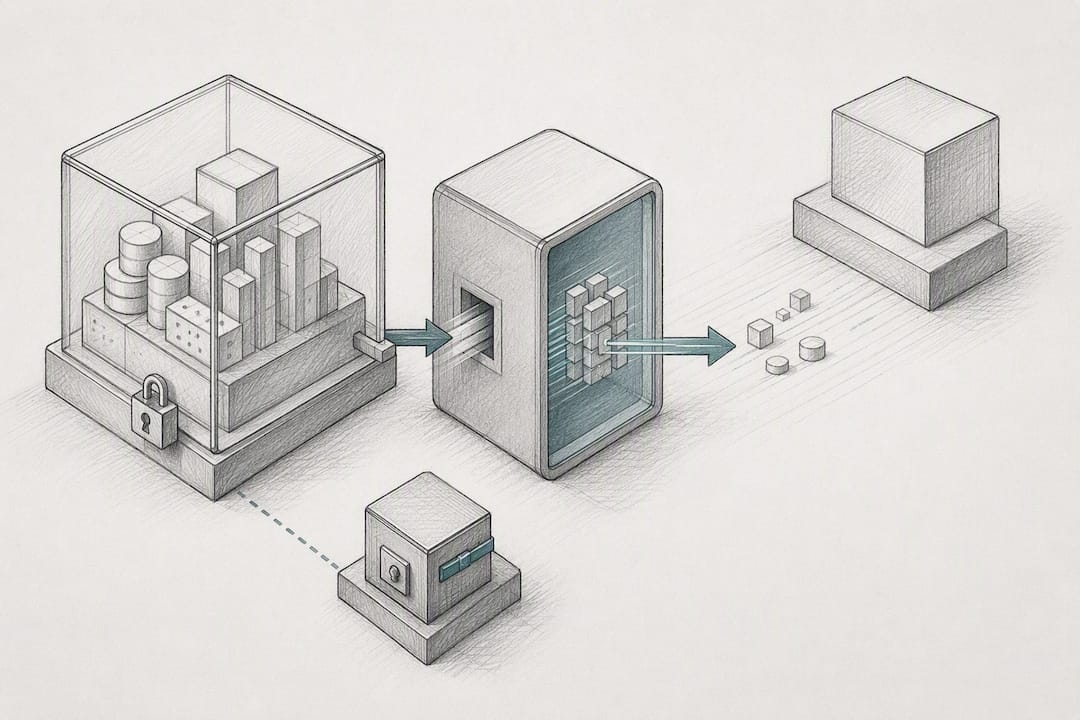
Some tools apply that architecture directly to clinical documentation. Chart preparation, summaries, and lab trend tracking may run against synced EMR data from common systems, and the transformation into de-identified or pseudonymized output happens on-device, before anything leaves the clinician’s machine. A nightly chart-prep workflow can generate summaries and follow-up reminders overnight, while any output destined for a research partnership or an AI training pipeline gets pseudonymized with a key that stays under the practice’s own control, not a vendor’s cloud infrastructure.
That matters for cross-border sharing in particular. A practice working with a research partner in another country doesn’t need to negotiate a full data transfer agreement for raw PHI if the shared dataset was already de-identified locally, before it crossed any border. The eSpiral case study illustrates this pattern in a real clinical AI integration, where PHI never leaves the local environment even as AI-driven insights get built on top of it.
Operationally, deploying this kind of on-device transform means logging every field touched and every technique applied, the same documentation discipline covered earlier, just automated as part of the workflow instead of handled as a manual, after-the-fact audit. The audit trail becomes a byproduct of normal operation, not a separate project someone has to run before a compliance review.
What Privacy Teams Get Wrong Most Often
If there’s one habit that causes more compliance headaches than any technical mistake, it’s treating “de-identified” and “anonymized” as synonyms in a policy document. They’re not, and the gap between them is exactly where GDPR exposure hides. A dataset that’s fully HIPAA de-identified under Safe Harbor can still be personal data under the GDPR’s linkage and inference tests, and I’d bet most cross-border data-sharing agreements have never actually confronted that gap directly.
The three pitfalls that show up again and again: mislabeling de-identified data as anonymous in contracts and public statements, which creates liability the moment someone actually tries to re-identify it; over-scrubbing data until it can’t answer the research question it was collected for, which wastes the entire project; and documentation so thin that a regulator’s first question, “what method did you use and what risk did you measure,” has no clear answer.
None of this requires exotic tooling to fix. It requires writing down the method, the adversary model, and the test results before the data ever leaves the building. Teams that treat that documentation as the deliverable, not an afterthought, are the ones who survive an audit without a scramble.
— Clint
Where MedScrub Fits Into a De-Identification Strategy
Most de-identification tools ask you to export patient data somewhere else to process it, which means the very data you’re trying to protect has to leave your control before it can be protected. Some solutions sync with major EMR systems, then perform de-identification directly on the clinician’s own machine, so raw PHI never has to travel to get transformed.
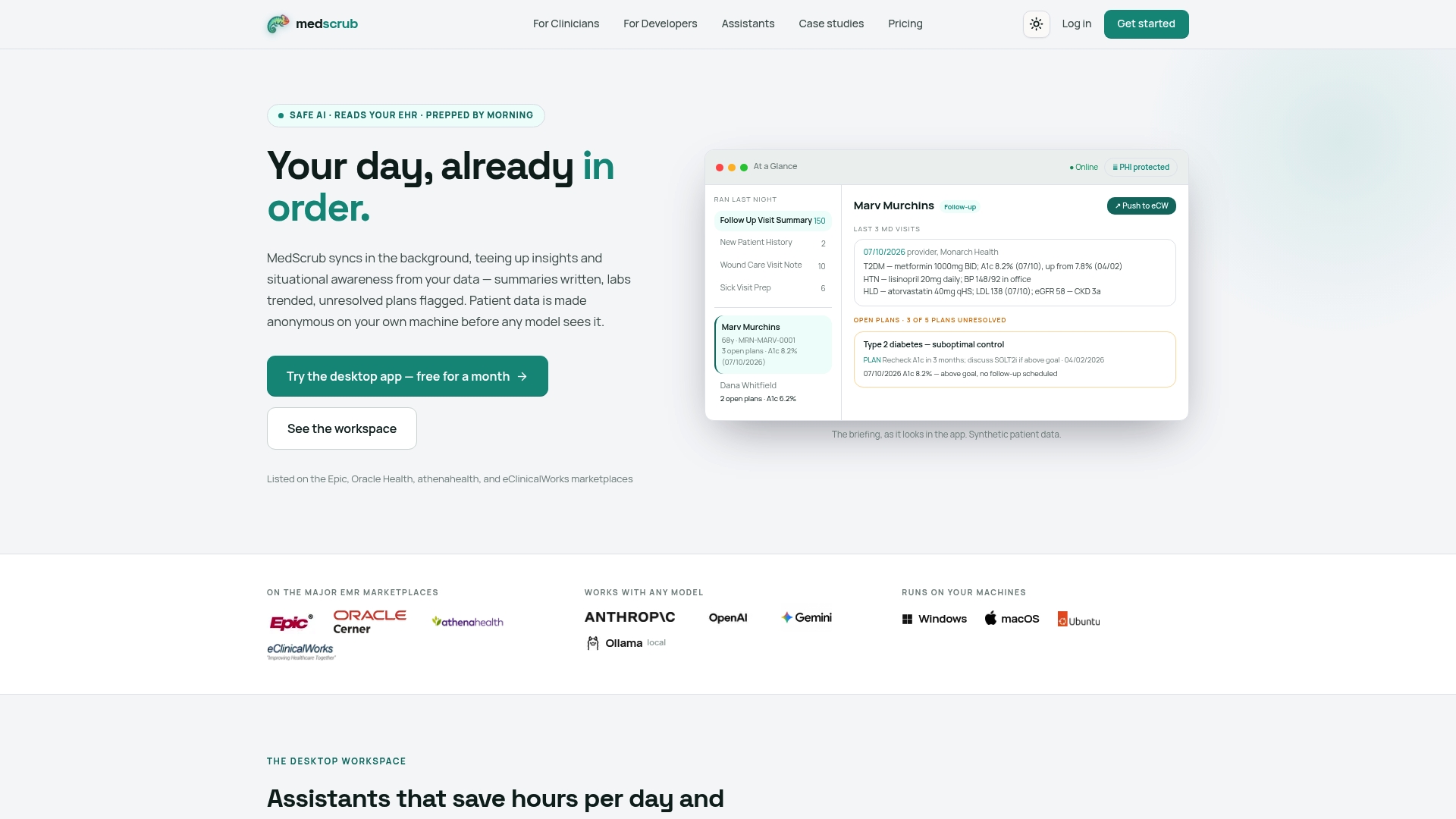
For clinical teams building AI-assisted workflows, research collaborations, or prior authorization drafting, that on-device boundary means the reversible pseudonymization options stay under your practice’s control, not a vendor’s server. Developers building on top of patient data can work through MedScrub’s PHI proxy API to get de-identified FHIR access without standing up their own transformation pipeline. Clinicians managing day-to-day documentation can see how the same architecture handles chart prep and follow-up tracking on the clinician-focused product page, or review how it played out in practice through the Monarch Health case study. If your team is evaluating a de-identification approach that doesn’t require rebuilding your data pipeline around a new cloud dependency, start with a technical walkthrough of how Medscrub handles PHI on-device.
Sources
For the technical foundation on de-identification methods, start with the NIST IR 8053 report, which covers Safe Harbor, Expert Determination, and known re-identification incidents. For the legal standard under EU law, the EDPB’s anonymisation guidelines lay out the three-part test regulators actually apply. For a practical, technique-focused walkthrough, the PDPC Guide to Anonymisation covers k-anonymity verification and utility trade-offs in plain language. Academic and research teams should also read the scoping review on terminology usage, which documents exactly how inconsistent these terms are across published biomedical research. Legal teams evaluating documentation obligations may also find value in analysis of the EDPB guidelines from a compliance perspective.
This article is general information, not a substitute for advice from a qualified lawyer. Consult a qualified legal professional about your own circumstances before acting on anything here.
- NIST IR 8053: De‑Identification of Personal Information
- EDPB guidelines on anonymisation (2026)
- Use and Understanding of Anonymization and De‑Identification in the Biomedical Literature: Scoping Review
FAQ
What is de-identification?
De-identification is a process that removes or transforms identifying information in a dataset so it can’t be easily linked back to a specific person, though some de-identified data can still be re-identified depending on the method used.
What does de-anonymization mean?
De-anonymization is the act of re-identifying individuals within a dataset that was previously de-identified or claimed to be anonymous, usually by linking it to outside data sources or exploiting quasi-identifier combinations.
What is another way to say “de-identified”?
Common alternatives include “pseudonymized” (when the transform is reversible), “masked,” or “redacted,” though each term describes a slightly different technique rather than a perfect synonym.
What is the difference between pseudonymization and de-identification?
Pseudonymization is one specific technique within the broader category of de-identification. It replaces identifiers with reversible tokens, while de-identification also includes irreversible techniques like generalization, masking, and aggregation.
Can de-identified data still be considered personal data under GDPR?
Yes. Data that’s de-identified but still linkable through a retained key or through combination with other data generally remains personal data under the GDPR, unlike data that meets the stricter anonymization standard.