Save Two Hours: HIPAA Safe On Device AI SOAP Notes for Clinicians
· 11 min read
Save Two Hours: HIPAA Safe On Device AI SOAP Notes for Clinicians
AI can generate usable SOAP notes for clinicians, but only with structured capture, clinician verification, and HIPAA-safe deployment. Speech recognition and language models can now draft a full note from a recorded visit in under a minute, and peer-reviewed reviews tie the technology to real time savings. But the same systematic review evidence shows documentation quality stays inconsistent, so every note still needs a clinician’s eyes before it hits the chart. Deployment models like MedScrub’s on-device approach show how that speed and that safeguard can coexist.
TL;DR:
- AI SOAP note systems can generate drafts quickly but still require clinician verification to prevent omissions, hallucinations, and coding errors.
- Input methods like dictation or ambient listening influence accuracy and time savings, with ambient capture demanding stricter quality controls.
- On-device processing with de-identification reduces risk and maintains privacy, while cloud-based tools depend on HIPAA-compliant BAA agreements for security.
- The clinician signing the note is legally responsible for its accuracy, emphasizing the importance of reviewing AI drafts thoroughly before finalization.
- Effective pilot programs should involve small, focused groups, tracking rewrite rates, coding mismatches, and clinician satisfaction to ensure safe and efficient deployment.
Table of Contents
- How Do AI SOAP Note Systems Actually Work?
- Dictation, Ambient Capture, or File Upload: Which Fits Your Visit?
- How Accurate Are AI-Generated SOAP Notes, and What Should You Check?
- EHR-Native or Standalone: Which Integration Protects Your Billing?
- What HIPAA Safeguards Should You Insist On Before Deployment?
- What Prompts and Templates Actually Save You Time?
- What Do Real MedScrub Deployments Show?
- Who Is Liable When an AI-Generated Note Contains an Error?
- A Practical Pilot Plan Worth Running Before Full Rollout
- MedScrub Fits the On-Device Workflow This Article Just Described
- Sources
How Do AI SOAP Note Systems Actually Work?
Every AI SOAP note generator runs the same basic pipeline: audio comes in, automatic speech recognition (ASR) turns it into text, natural language processing (NLP) sorts that text into clinical concepts, and a template engine slots those concepts into Subjective, Objective, Assessment, and Plan. Each stage is a place where something can go wrong. ASR mishears a drug name. NLP misclassifies a symptom as a diagnosis. The template forces a nuance into the wrong field.
Three model families handle this differently:
- Rule-based systems extract structured items like medication lists and allergies with high precision, but they struggle with free-flowing narrative.
- Hybrid systems blend rule-based extraction with generative phrasing, giving you structure where it matters and readability where it helps.
- Fully generative models write the most natural-sounding notes but carry the highest hallucination risk.
By the numbers: A systematic review of 129 studies found AI tools reach high accuracy on narrow tasks like structuring free text and flagging clinical concepts, but no end-to-end documentation assistant has yet proven consistently accurate enough for unsupervised use.
Dictation, Ambient Capture, or File Upload: Which Fits Your Visit?
The input method you choose shapes both your turnaround time and your error rate. Here’s how the main options stack up:
- Typed notes with keyword prompts give you the most control and the lowest hallucination risk, but they take the longest and offer the smallest time savings.
- Live dictation cuts drafting time substantially and works well for clinicians who think out loud during exams, though background noise and cross-talk hurt accuracy.
- Uploaded audio files (recorded on a separate device) let you capture a full visit without juggling software mid-exam, with turnaround typically ready within minutes of upload.
- Ambient/telehealth capture, where the system listens passively during the encounter, saves the most time but demands the tightest quality controls: a good microphone, speaker identification, and structured check-in prompts at the start of the visit.
Whichever method you pick, workflow research on ambient scribes makes one point clear: success depends less on the tool and more on deliberately redesigning how you talk during the visit.
How Accurate Are AI-Generated SOAP Notes, and What Should You Check?
Ambient AI scribes consistently save documentation time, but a narrative review covering 18 studies found they also produce omissions and, occasionally, clinically significant hallucinations. Speed and safety are not the same metric, and treating them as one is how errors reach a chart.
The recurring failure patterns worth watching for:
- Hallucinated details — a symptom, dosage, or finding the patient never mentioned.
- Flattened nuance — subjective complaints reduced to a generic phrase that loses clinical meaning.
- Coding mismatches — an ICD-10 or CPT suggestion that doesn’t match the documented encounter.
- Silent omissions — something said in the room that never made it into the draft at all.
Statistic to remember: Reviews of AI scribe deployments report decreased documentation time without a matching drop in clinician burnout, largely because verification work replaces typing work rather than eliminating it.
Pro Tip: Read the Assessment and Plan sections first, not last. That’s where hallucinations do the most damage, and where a rushed final scan is most likely to miss them.
Before signing any AI-drafted note, confirm the chief complaint matches your memory of the visit, check every medication and dosage against the chart, verify the coding suggestion against documented services, and reject the draft outright if the Plan section contains an instruction you didn’t give.
EHR-Native or Standalone: Which Integration Protects Your Billing?
EHR-native tools write directly into the patient’s chart and often surface coding suggestions inline, which cuts the re-entry errors that come from copying a note between systems. Vendor implementation reports describe this coding suggestion flow reducing billing mismatches compared to standalone generators that require a manual copy-paste step into the EHR.
Standalone tools still have a place, especially for clinicians whose EHR lacks native AI features, but the copy-paste step is exactly where formatting breaks and fields go missing.
Before trusting any integration with real charts, confirm:
- A signed Business Associate Agreement (BAA) covers the AI vendor.
- The system keeps an audit log of every AI-generated note and every edit made to it.
- Coding suggestions are labeled clearly as suggestions, not final codes, until a clinician confirms them.
- Data retention policy states how long draft notes live before deletion, and where.
What HIPAA Safeguards Should You Insist On Before Deployment?
Three deployment patterns dominate the market right now, and each carries a different risk profile.
- Cloud-based with a BAA is the most common setup: audio and text pass through a vendor’s servers, and a signed BAA makes that vendor a HIPAA-accountable business associate.
- On-device or offline processing keeps audio and PHI on the clinician’s own machine, which sidesteps most cloud-transmission risk entirely.
- Hybrid models de-identify PHI on-device before anything touches the cloud, then reverse the de-identification locally once the note comes back.
At minimum, confirm the vendor uses TLS encryption in transit and AES-256 at rest, publishes a clear data retention window, and enforces role-based access so only the treating clinician and authorized staff can open a draft note.
Pro Tip: Get audio-recording consent language into your intake paperwork now, even if you’re only piloting AI notes. Retrofitting consent after a patient complaint is a much harder conversation.
What Prompts and Templates Actually Save You Time?
Specialty-specific starting prompts cut editing time more than generic ones. A psychiatry prompt should request a structured mental status exam and explicit risk assessment language. A primary care prompt should ask for problem-based Assessment and Plan sections tied to each active diagnosis. Physical therapy notes benefit from a prompt that requests objective measurements (range of motion, strength grading) in a consistent format. Nursing documentation prompts should specify vital trend call-outs and care-gap flags.
You can ask most generators to suggest ICD-10 and CPT codes inline. Request bullet format for Objective findings and narrative format for Subjective and Assessment; it reads faster on review. Dynamic picklists for allergies and musculoskeletal laterality meaningfully cut extraction errors in specialty documentation, so use them when your platform offers them.
- Do specify the exact template structure you want in your prompt.
- Do ask the system to flag any statement it inferred rather than heard directly.
- Don’t accept a Plan section with medication instructions you didn’t explicitly state.
What Do Real MedScrub Deployments Show?
MedScrub syncs with Epic, Oracle Health, and other major EMRs, then anonymizes patient data on-device before any AI processing happens, so PHI never sits on an external server. Clinicians using the platform report saving an average of two hours a day on administrative work, time that shifts back to patients rather than paperwork.
The eSpiral case study documents a deployment where chart-aware AI assistance ran entirely with on-device de-identification, keeping PHI out of the cloud while still giving clinicians full chart context during the visit.
That pattern maps directly onto the verification checklist above: BAA-backed cloud processing is one valid path, but on-device de-identification is another, and it changes your contractual risk exposure. If you’re evaluating either model, the Monarch Health case study is worth a look before you commit to a pilot.
Who Is Liable When an AI-Generated Note Contains an Error?
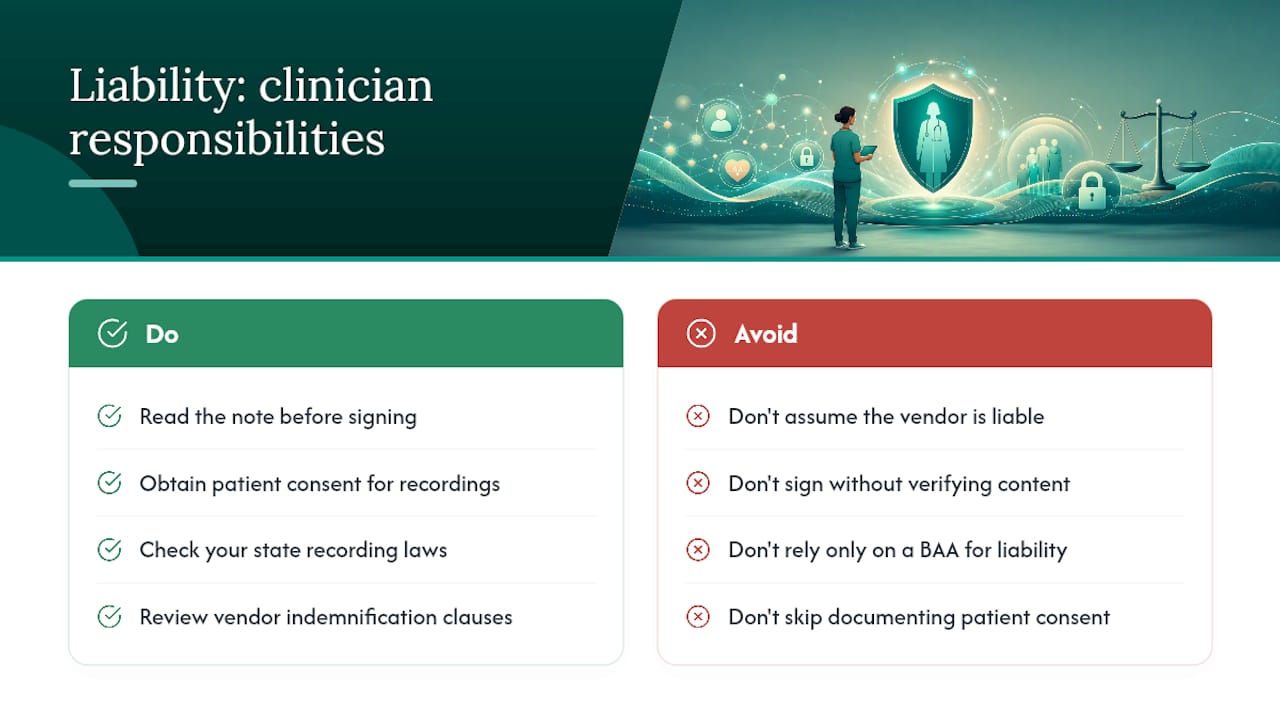
The clinician who signs the note carries the liability, not the software vendor. That single fact should shape every workflow decision you make around AI documentation. A signed SOAP note is a legal representation that the clinician reviewed and stands behind its contents, regardless of what generated the first draft. Courts and licensing boards have historically held clinicians accountable for chart accuracy even when a transcriptionist, scribe, or dictation service produced the raw text, and there’s no reason to expect AI tools to be treated differently.
This creates a specific ethical obligation: never sign a note you haven’t actually read. It sounds obvious, but the entire appeal of AI SOAP notes is speed, and speed creates pressure to rubber-stamp. A note that takes 90 seconds to generate but 90 seconds to properly verify has saved you nothing in liability terms, even if it saved you typing time.
Informed consent adds another layer. Patients generally have a right to know when a third-party tool, human or AI, is documenting their visit, particularly when audio is being recorded. Most state laws around recording conversations apply here, and consent requirements vary by jurisdiction, so check your state’s specific recording laws before adopting ambient capture rather than assuming a blanket policy covers you everywhere you practice.
Vendor contracts matter too. A BAA covers HIPAA compliance, but it rarely addresses who absorb the cost if an AI error leads to a malpractice claim. Read the liability and indemnification clauses in any AI SOAP note vendor contract as carefully as you’d read a malpractice policy, because that’s effectively what it is.
A Practical Pilot Plan Worth Running Before Full Rollout
Start small: five to ten clinicians, four weeks, one specialty. Track edit time per note, the percentage requiring a full rewrite, coding mismatch rate, and clinician satisfaction, not just raw minutes saved. If rewrite rates stay above a fifth of all notes after two weeks, pause and retrain on prompts before scaling further. Build in a weekly 15-minute check-in where clinicians flag hallucinations they caught, since that pattern data matters more than the topline time savings.
— Clint
MedScrub Fits the On-Device Workflow This Article Just Described
Every safeguard covered above, on-device de-identification, BAA-backed access controls, audit-ready coding suggestions, can be part of some AI SOAP note workflows. Some tools sync with multiple major EMRs, then run chart prep, SOAP note generation, and follow-up tracking with PHI anonymized locally before any AI model touches it.
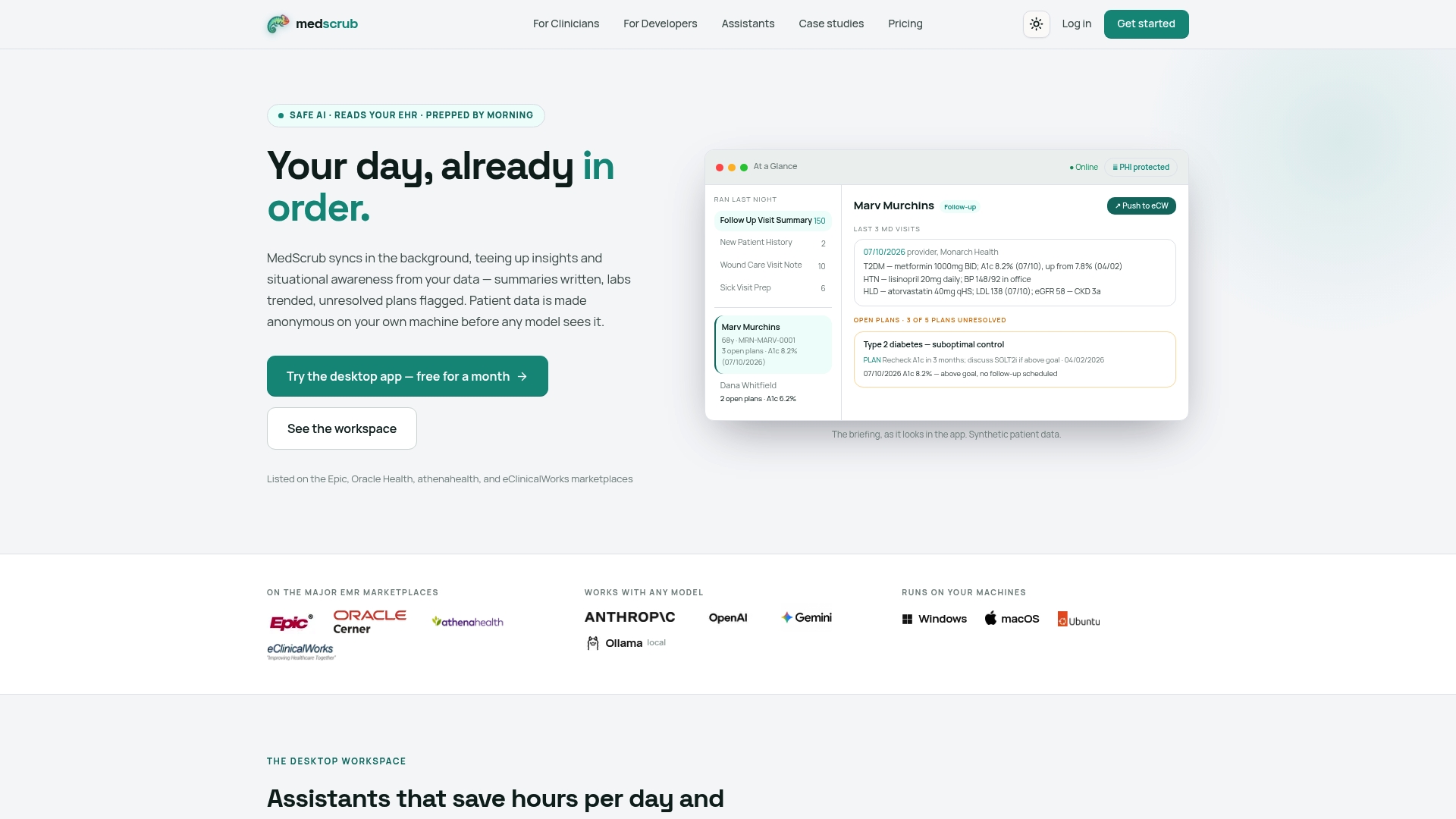
If the verification checklist in this article gave you pause about cloud-only tools, that’s exactly the gap MedScrub’s on-device processing is built to close. Clinicians using the platform report saving roughly two hours daily on documentation, and the eSpiral case study and Monarch Health case study walk through how that plays out in real practices. Developers building on top of the platform can review the PHI proxy API for integration details. Start by visiting the clinician page to see current plans and request a pilot for your practice.
Sources
For deeper technical background, the systematic review on AI scribes and clinical documentation and the narrative review on ambient AI scribes cover implementation risks in detail. NexoLab’s research blog also covers how AI structures clinical text. For specialty-specific documentation demands, orthopedic surgeon Dr. Luigi Manzi’s practice site illustrates the kind of niche terminology picklists need to handle. Browse MedScrub’s full case study library for more implementation examples.
This article is general information, not a substitute for advice from a qualified doctor. Consult a qualified healthcare professional about your own circumstances before acting on anything here.
- PubMed - systematic review (2025–2026) summary
- Improving Clinical Documentation with Artificial Intelligence: a Systematic Review


