Clinicians: Save Two Hours a Day With Privacy First AI Scribes
· 11 min read

Clinicians: Save Two Hours a Day With Privacy First AI Scribes
AI medical scribes are worth adopting now, provided a clinician reviews every note before it hits the chart. A systematic review and meta-analysis found a moderate, measurable drop in documentation workload across studies. The catch: accuracy still varies by vendor and specialty, so the real gain depends on picking a tool with strong error auditing and on-device or contractually locked-down PHI handling.
TL;DR:
- Accuracy varies by vendor and specialty, so selecting tools with strong error auditing and PHI handling is crucial for reliable documentation.
- On-device processing reduces PHI exposure and is essential if your practice cannot accept data leaving your network, but requires strong infrastructure proof.
- AI scribes lower documentation workload moderately, but time savings do not guarantee reduced clinician burnout, which depends on multiple factors.
- The main errors involve omissions, which are particularly risky in high-acuity cases, making clinician review mandatory before finalizing notes.
- Successful implementation involves a staged workflow shift and ongoing tracking of documentation time, edit rates, and error types during pilot periods.
Table of Contents
- How Does Medical Scribe AI Actually Work?
- What Do Studies Actually Show About Time Savings and Burnout?
- Where Do AI Scribes Get It Wrong?
- How Does an AI Scribe Fit Into Your Daily Workflow?
- What Should You Ask a Vendor Before You Sign?
- Why On-Device Processing Matters for PHI Protection
- Does AI Scribing Change What Clinicians Decide, and How Patients Fare?
- What Compliance Rules Apply to AI Medical Scribes?
- Clinician Perspective: What the First Month Actually Looks Like
- Medscrub: A Privacy-First Way to Pilot an AI Scribe
- Sources
How Does Medical Scribe AI Actually Work?
A medical scribe AI is not one algorithm. It’s a pipeline. Automated speech recognition (ASR) transcribes the visit, natural language processing (NLP) tags clinical concepts inside that transcript, and a large language model (LLM) turns those tags into a structured note. A narrative review of ambient AI scribe technology breaks this pipeline down and explains why errors tend to cluster at the NLP-to-LLM handoff, where meaning gets compressed.
Most tools on the market today run in one of three modes:
- Ambient capture: listens passively during the visit and drafts a note afterward.
- Assistant mode: clinician dictates or prompts, and the AI drafts on demand.
- Previsit summarizer: pulls chart history into a summary before the patient walks in.
Specialty customization matters more than most vendors admit upfront. A dermatology visit and a cardiology consult use wildly different vocabularies, and a generic model trained mostly on primary care encounters will misfire on procedural detail.
What Do Studies Actually Show About Time Savings and Burnout?
The number that matters: the UEA-led meta-analysis reports a moderate standardized mean difference reduction in documentation burden across the pooled studies. That’s a real signal, not a rounding error, but “moderate” is the operative word.
Time savings reported across trials vary widely. Some clinics see meaningful drops in after-hours charting; others see marginal change once staff account for editing time. A systematic review on AI and clinical documentation found effects on clinician burnout were mixed even where documentation time fell, because burnout is driven by more than typing speed.
What this means for your pilot:
- Don’t assume time savings translate one-to-one into burnout relief.
- Track documentation time AND self-reported satisfaction separately.
- Expect variability by specialty and patient volume, not a flat percentage.
- Reassess at 30, 60, and 90 days rather than judging week one.
Where Do AI Scribes Get It Wrong?
Three error types show up repeatedly in the literature. Omissions drop details the AI didn’t recognize as clinically relevant. Additions (sometimes called fabrications or hallucinations) invent details that were never said. Incorrect facts misattribute a symptom, medication, or lab value to the wrong context. The PMC narrative review found omission is the dominant error type across the studies it analyzed, which is arguably the more dangerous failure mode because it’s easy to miss on a quick read.
High-acuity specialties carry more risk from the same error. A dropped detail in a routine follow-up is an inconvenience. A dropped detail in an oncology or ICU note can shape a treatment decision.
Mitigation isn’t complicated, but it has to be consistent:
- Mandatory clinician review before signing any AI-drafted note.
- Specialty-specific templates that force key fields (allergies, dosages, vitals) into visibility.
- Audit trails that log what the AI generated versus what the clinician edited.
- Periodic spot audits comparing a sample of AI notes against the actual recording or encounter.
Pro Tip: Run your first two weeks of AI-drafted notes through a side-by-side diff against your own memory of the visit. You’ll learn your tool’s specific blind spots faster than any vendor demo will tell you.
How Does an AI Scribe Fit Into Your Daily Workflow?
The workflow shift happens in three stages, and each one changes what staff actually do during the day.
- Previsit: the AI pulls chart history, recent labs, and open care gaps into a summary clinicians can scan in under a minute instead of clicking through five tabs.
- During visit: ambient tools capture the conversation while the clinician stays focused on the patient instead of the keyboard; assistant-mode tools require active prompting.
- Postvisit: the draft note lands for review, often with coding suggestions attached, before it’s finalized and billed.
EHR integration comes in two flavors: an embedded API connection (the AI writes directly into Epic or Oracle Health fields) or a desktop sync model that pulls and pushes data without living inside the EHR itself. Ask vendors specifically which model they use. It changes IT approval timelines significantly.
Expect an adjustment period. Field reports from large health systems, including Permanente’s analysis of ambient AI scribes, describe real time savings alongside genuine rollout friction as staff adapt to new habits.
What Should You Ask a Vendor Before You Sign?
Selection criteria worth putting in writing before any contract: accuracy benchmarks tested on your specialty’s vocabulary, deployment model (cloud versus on-device), a signed BAA, and an auditable log of AI-generated versus clinician-edited content.
During the pilot itself, track:
- Documentation time per encounter, before and after.
- Edit rate. A high edit rate on a “fast” note usually means the AI is generating more work than it saves, a distinction the systematic review on AI documentation tools flags directly.
- Error type and frequency, sorted by omission, addition, and fact error.
- Clinician satisfaction, measured separately from raw time savings.
Sample questions worth asking directly: “Where does PHI live during processing, and does it ever leave our network?” “What’s your omission rate on encounters longer than 20 minutes?” “Can we export an audit trail for compliance review?”
Pro Tip: If a vendor can’t give you a straight answer on where PHI physically travels during processing, that’s the red flag. Ask again before you ask about pricing.
Why On-Device Processing Matters for PHI Protection
On-device processing and a solid BAA reduce PHI exposure risk compared with sending raw patient data to cloud training pipelines, a distinction guidance on healthcare AI deployment emphasizes for any practice handling sensitive records. One tool built around that exact principle syncs with major EMRs while running de-identification locally, so PHI stays on the clinician’s machine rather than traveling to a third-party server.
Practical outcomes clinicians report align with the broader evidence base. Medscrub’s own clinician-facing product documents an average of two hours saved per day when chart prep, summaries, and follow-up tracking run automatically instead of manually.
“PHI never in the cloud” isn’t a slogan here. It’s the architecture. The eSpiral case study shows what that looks like in an actual clinical deployment, with local processing built into the rollout from day one.
On-device is the preferred model when a practice can’t accept PHI leaving its control at all, whether for contractual, regulatory, or plain risk-tolerance reasons. Before choosing that route, ask for proof: a case study, an architecture diagram, or a direct explanation of what data (if any) ever touches a vendor’s servers.
Does AI Scribing Change What Clinicians Decide, and How Patients Fare?
The honest answer is that AI scribes don’t make clinical decisions. They change how much attention a clinician has left to make them well. When documentation stops eating the visit, clinicians look at patients instead of screens, and that shift shows up in the quality of the conversation, not just the note.
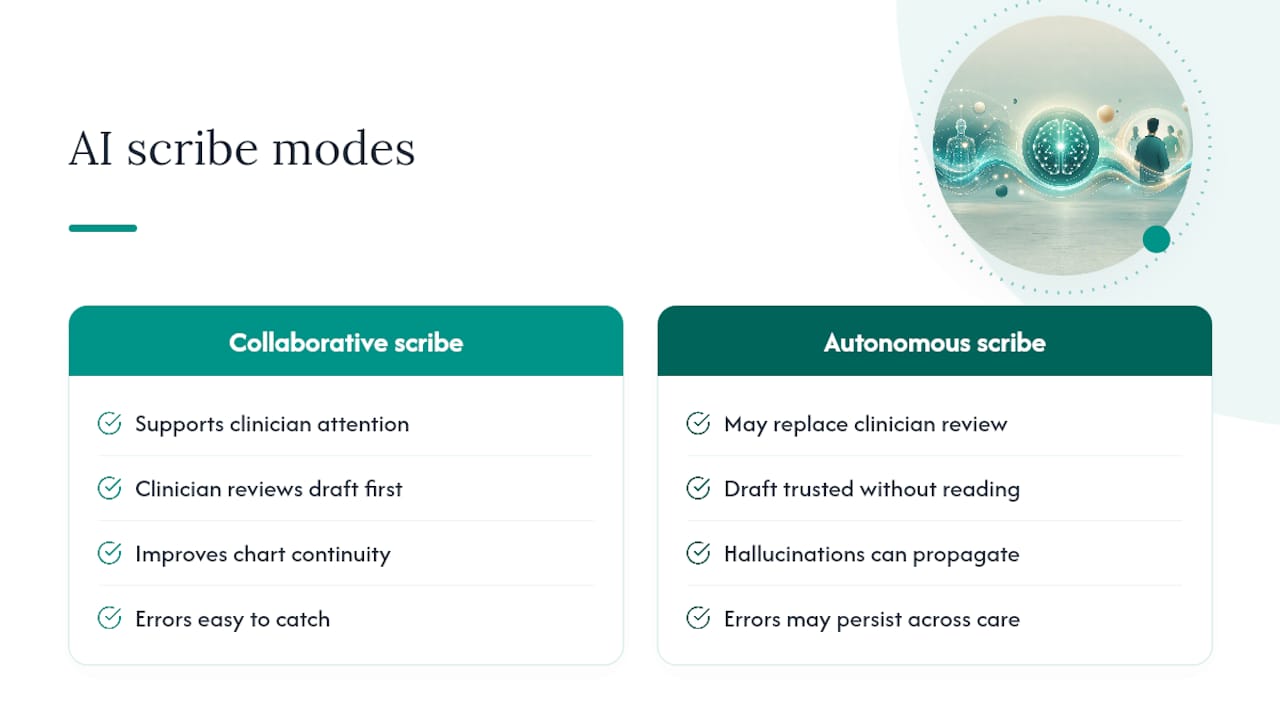
An insight from the ambient scribe literature makes a point worth sitting with: these tools work best as collaborative assistants, not autonomous note writers. That distinction shapes decision-making directly. A clinician who trusts an AI draft without reading it risks carrying forward an omission into a treatment plan. A clinician who treats the draft as a first pass, correcting it against memory of the actual visit, gets the time benefit without inheriting the risk.
There’s a second-order effect on outcomes that’s easy to overlook: better chart continuity. When previsit summaries surface an unresolved care gap or a lab trend heading the wrong direction, clinicians catch problems that a rushed chart review would have missed. That’s not a documentation win. It’s a patient-safety win wearing documentation clothing.
The risk runs the other direction too. A hallucinated detail that survives into a note can propagate through referrals, billing, and future visits, compounding a small AI error into a real clinical inconsistency. The tools that earn trust are the ones that make errors easy to catch, not the ones that promise there won’t be any.
What Compliance Rules Apply to AI Medical Scribes?
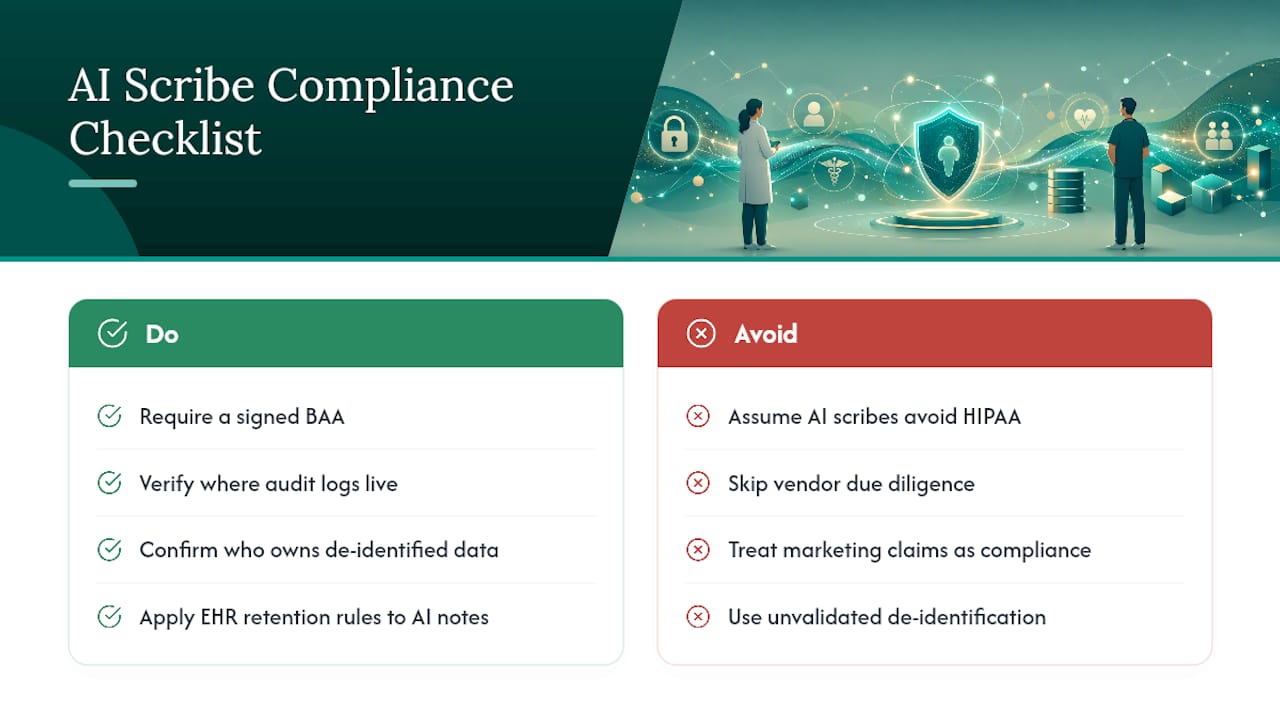
AI medical scribes touch protected health information, which puts them squarely under HIPAA regardless of how “AI” the marketing sounds. Any vendor processing PHI needs a signed Business Associate Agreement (BAA), full stop. That’s non-negotiable groundwork, not a nice-to-have feature.
Beyond HIPAA, Safe Harbor de-identification standards matter if a practice wants to use scribe output or aggregated data for purposes like research or quality improvement without the same PHI restrictions. On-device de-identification architectures, the kind described in guidance on PHI proxy design for clinical AI, can simplify this considerably by stripping identifiers before any external process ever touches the data.
There’s no dedicated federal regulatory framework specific to AI scribes as of 2026, which means the compliance burden falls on standard healthcare data law plus whatever contractual terms a vendor is willing to put in writing. That gap cuts both ways: it gives practices flexibility, but it also means the burden of due diligence sits with the buyer, not a regulator. Ask for the BAA in writing. Ask where audit logs live. Ask who owns the de-identified data downstream. None of that is optional homework, even when a product looks polished.
Documentation retention rules that already govern your EHR still apply to AI-generated notes. An AI draft that becomes part of the permanent record follows the same retention and correction rules as anything a human typed.
Clinician Perspective: What the First Month Actually Looks Like
Adoption isn’t instant. Expect a real slowdown in week one as staff learn to trust, then verify, the draft. That friction is normal, not a sign the tool failed.
The clinicians who get the most value treat AI drafts as a colleague’s rough note, not a finished chart. Set milestones at 30 and 60 days. If edit rates and documentation time haven’t improved by then, the tool or the workflow needs adjusting, not more patience.
— Clint
Medscrub: A Privacy-First Way to Pilot an AI Scribe
If PHI leaving your network is the dealbreaker that’s kept you from trying an AI scribe, one product was built around that exact concern. It syncs directly with major EMRs and de-identifies patient data on your own machine before anything touches a model, cloud or local.
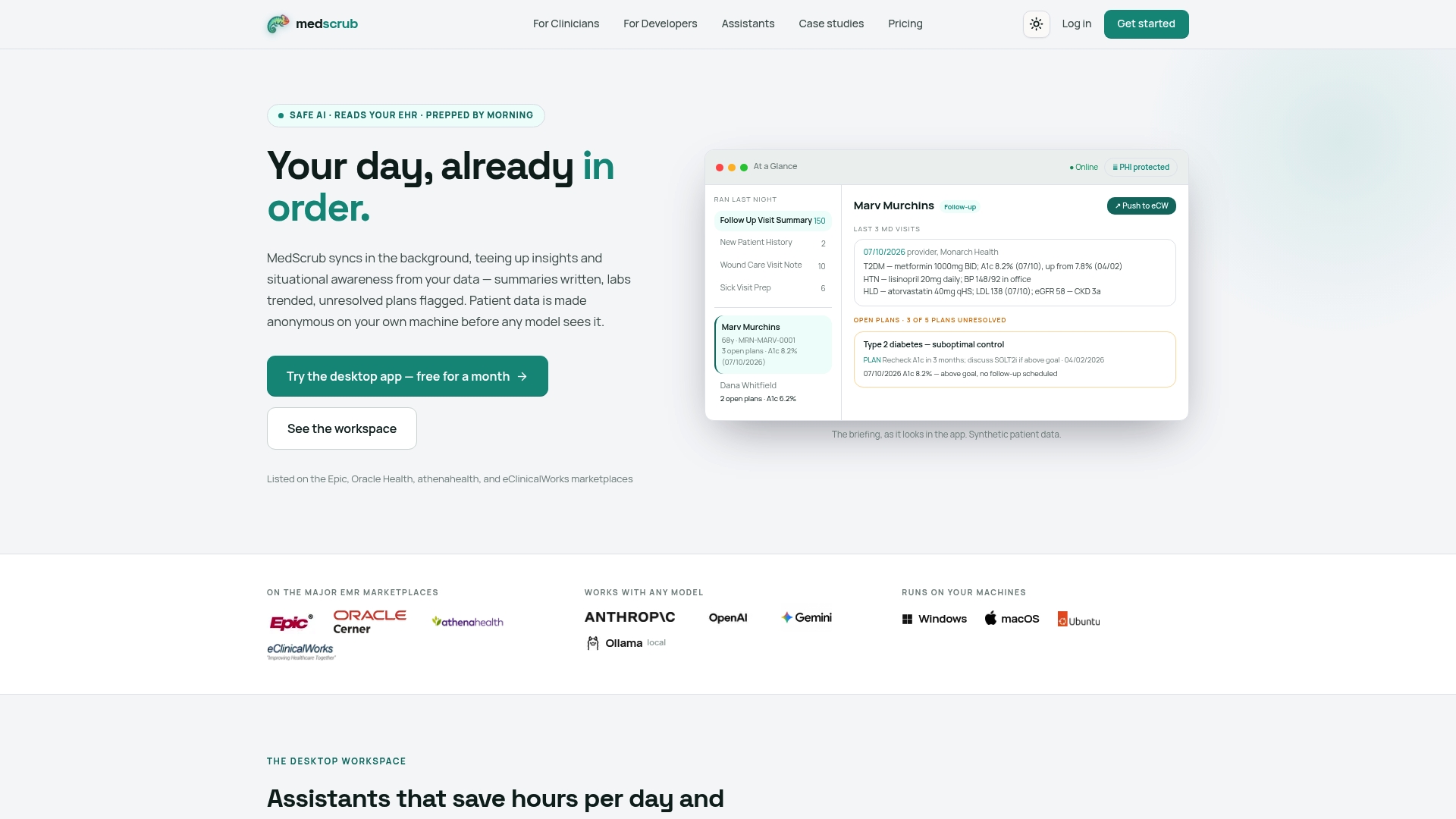
The practical payoff shows up in hours, not abstractions: Some clinicians report saving substantial time daily on chart prep, summaries, and follow-up tracking, freeing that time for actual patient care. The eSpiral case study walks through what a real on-device deployment looks like, including the workflow redesign that made it stick.
If you’re ready to see how that fits your own charting load, start with Medscrub’s clinician page and walk through a trial built around your specialty and your EHR.
Sources
- Application of artificial intelligence tools and clinical documentation burden: a systematic review and meta-analysis
- Transforming clinical documentation with ambient artificial intelligence (AI) scribes: a narrative review of technology, impact, and implementation - PMC
This article is general information, not a substitute for advice from a qualified doctor. Consult a qualified healthcare professional about your own circumstances before acting on anything here.


