Clinics: Pilot a Clinical AI Chatbot in 30–90 Days and Keep PHI Local
· 9 min read

Clinics: Pilot a Clinical AI Chatbot in 30–90 Days and Keep PHI Local
A clinical AI chatbot is a chart-aware assistant that drafts notes, summaries, and reminders inside a clinician’s own workflow, never a patient-facing symptom checker. The safe baseline is simple: PHI gets de-identified on-device or through a PHI proxy before anything leaves clinician hardware, a signed business associate agreement covers any vendor that touches ePHI, and a clinician reviews and signs every draft before it hits the chart.
TL;DR:
- Clinical AI chatbots must read and write through FHIR interfaces and integrate with EMR systems like Epic to ensure accurate chart context.
- On-device de-identification using local recognition is essential to keep protected health information off cloud servers and meet HIPAA compliance.
- Vendors should provide clear documentation of privacy architectures, legal agreements, and clinical safety measures, including version control and clinician review protocols.
- Pilots should focus on a single use case, establish before-start metrics, and incorporate human-in-the-loop signoff processes to minimize risk and gather relevant data.
- Ongoing governance, including risk assessments and strict signoff procedures, is crucial to successful adoption rather than a one-time technical deployment.
Table of Contents
- What an EMR-integrated clinical AI chatbot actually does
- What should you check before buying or piloting one?
- How privacy architectures keep PHI off vendor clouds
- How to pilot a clinical AI chatbot without breaking anything
- How MedScrub applies this checklist in practice
- What clinics keep getting wrong about adoption
- Evaluating MedScrub for your own pilot
- Sources
- FAQ
What an EMR-integrated clinical AI chatbot actually does
Strip away the marketing language and the category boils down to five jobs: drafting SOAP notes, summarizing chart history, flagging overdue follow-ups, answering chart-aware questions in plain language, and populating specialty templates. These tools pull context from FHIR resources and EMR connectors, which is why integration quality matters more than model quality. A chatbot that can’t see medication lists, problem lists, or recent labs produces generic drafts no better than a blank template.
This is a different animal from the patient-facing chatbots that handle symptom triage or appointment booking. Those consumer tools talk to patients about their own health. A clinical AI chatbot talks to clinicians about the chart, and it never gets deployed in front of patients directly.
What should you check before buying or piloting one?
Vendor demos look polished. The gap between a demo and a defensible deployment shows up in five places, and skipping any one of them tends to surface as a compliance or safety problem months later.
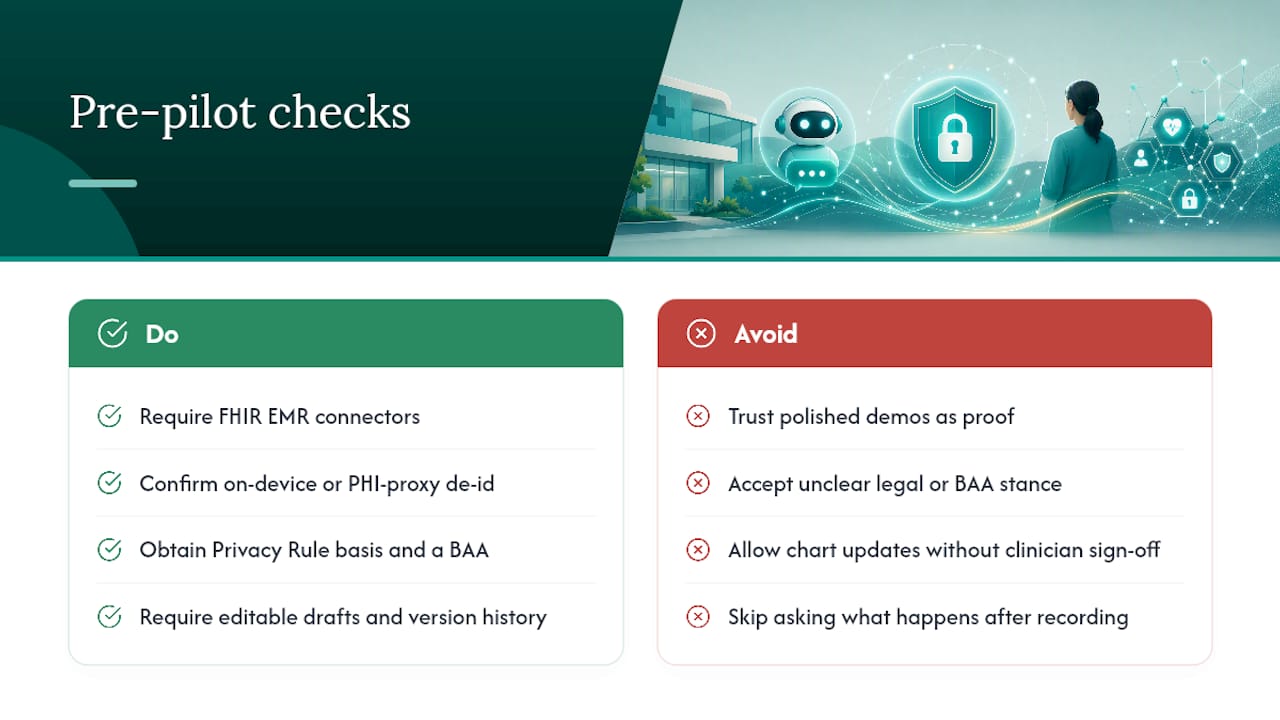
Integration. Confirm the tool reads and writes through FHIR, not a brittle screen-scrape, and ask exactly how EMR connectors for Epic, Oracle Health, athenahealth, or eClinicalWorks map outputs to specific note types.
Privacy architecture. Ask whether de-identification happens on-device or through a PHI proxy before data ever reaches a model, what encryption protects data at rest and in transit, and what the retention policy is for any transcript or draft.
Legal footing. Every vendor should be able to state its documented Privacy Rule basis in plain terms and provide a business associate agreement when it processes ePHI. If a sales rep can’t answer this cleanly, that’s a red flag, not a technicality.
Clinical safety. Drafts must stay editable, changes need version history, and nothing updates the chart without a clinician’s signature.
Operations. Look for specialty-specific templates, role-based access controls, and a real training plan, not a PDF.
Pro Tip: Ask the vendor to walk you through what happens to a voice recording or transcript in the ten seconds after it’s captured. If they can’t answer specifically, on-device redaction, encrypted transit, and immediate deletion, in that order, treat that as a disqualifying gap, not a follow-up question.
How privacy architectures keep PHI off vendor clouds
The strongest architectures redact protected information before it ever leaves the clinician’s machine. On-device de-identification uses local named-entity recognition to detect and strip HIPAA Safe Harbor identifiers, names, dates, medical record numbers, and the rest of the 18-item list, before any transmission happens. A PHI proxy accomplishes something similar for tools that need cloud inference: it de-identifies data in transit, sends the sanitized version to the model, then re-identifies the result locally.
None of this eliminates the need for governance. A BAA is required whenever a vendor hosts or processes PHI in any form, audio, transcripts, or notes, and HHS guidance is explicit that no single certification makes an AI product “HIPAA-compliant.” Compliance is a documented Privacy Rule basis plus Security Rule safeguards across the whole stack, not a badge on a vendor’s website.
The trade-off is real. Cloud models tend to update faster and support more complex reasoning, while on-device models keep raw PHI local but need more careful version control to stay auditable. Mitigate this by:
- Maintaining a written inventory of every tool that touches ePHI
- Logging model version alongside every generated draft
- Running a documented risk analysis before go-live, not after
State law can add obligations HIPAA doesn’t cover, so governance plans need to check local requirements too, not just federal rules.
How to pilot a clinical AI chatbot without breaking anything
A narrow, well-measured pilot beats a broad rollout every time. Here’s a sequence that keeps risk contained while still producing usable data.
- Pick one narrow use case. Progress notes for a single specialty or one high-volume visit type, not the entire practice at once.
- Set your metrics before day one. Track time spent in notes, the edit rate on AI-generated drafts, and downstream order-correction events.
- Map outputs to FHIR resources and note types. Keep every draft quarantined in a review interface until a clinician signs it and the EHR mapping job runs.
- Build the review-and-signoff step into the workflow, not as an afterthought. A human-in-the-loop design means AI drafts and the clinician approves, every time, with no exceptions during the pilot phase.
- Name clinician champions who get one-on-one onboarding and can answer peer questions in real time.
- Run periodic audits and keep a feedback loop open so edit patterns inform template and prompt adjustments.
Pro Tip: Track edit distance, not just edit rate. A note that gets touched once but has three sentences rewritten tells you more about model quality than five notes with a single comma fixed.
How MedScrub applies this checklist in practice
Some clinical AI chatbots sync with EMR systems such as Epic, Oracle Health, athenahealth, and eClinicalWorks, and perform PHI de-identification on-device rather than routing raw chart data through a cloud pipeline first. That’s the architecture the checklist above calls for: chart-aware chat, automated summaries, reminders, and SOAP note drafts, built on top of a plain-English assistant builder with support for multiple LLM providers.
Some vendors report that clinicians using their tools save significant time on documentation, a vendor claim worth verifying against your own pilot metrics rather than taking at face value. The eSpiral case study is a useful reference point here: it documents an integration where PHI never leaves the device, which is exactly the kind of proof point a procurement team should ask any vendor, including MedScrub, to demonstrate before signing anything.
What clinics keep getting wrong about adoption
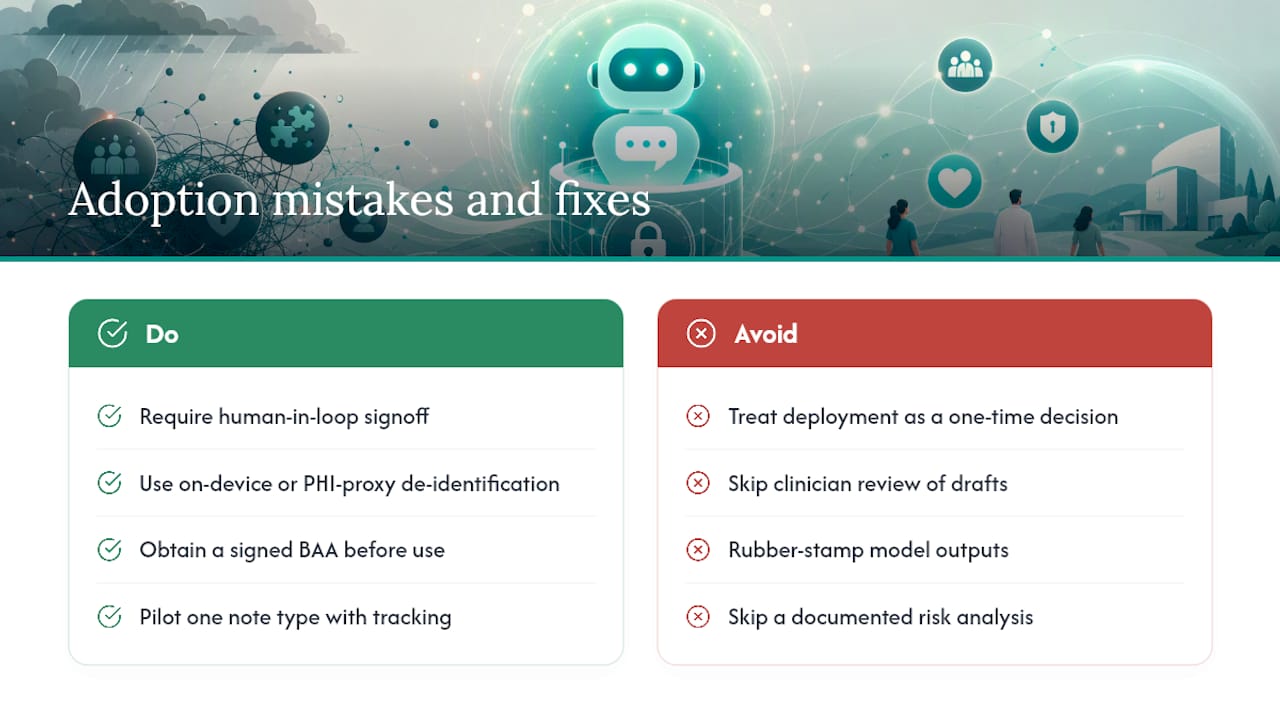
The mistake I see most often isn’t picking the wrong vendor. It’s treating deployment as a one-time technical decision instead of an ongoing governance practice. A systematic review of AI documentation tools found a meaningful reduction in documentation workload, but only when clinicians actually reviewed and edited the drafts rather than rubber-stamping them. Skip the review step to save five more minutes, and you’ve traded a documentation problem for a safety problem.
My practical recommendation: on-device or PHI-proxy de-identification, a signed BAA, and a hard human-in-the-loop signoff step, before anything else. Start with two moves in the next 30 to 90 days: run a documented risk analysis on one candidate tool, and pilot it on a single note type with edit rate and time-in-notes tracked from day one.
— Clint
Evaluating MedScrub for your own pilot
If you’re the kind of reader who wants proof before a demo call, start with the eSpiral case study, which walks through a deployment where PHI stayed on-device from capture to chart update. Certain clinical AI chatbots are built to include features such as on-device de-identification, EMR sync with systems like Epic and Oracle Health, and a review workflow that keeps clinicians signing off before anything touches the record.
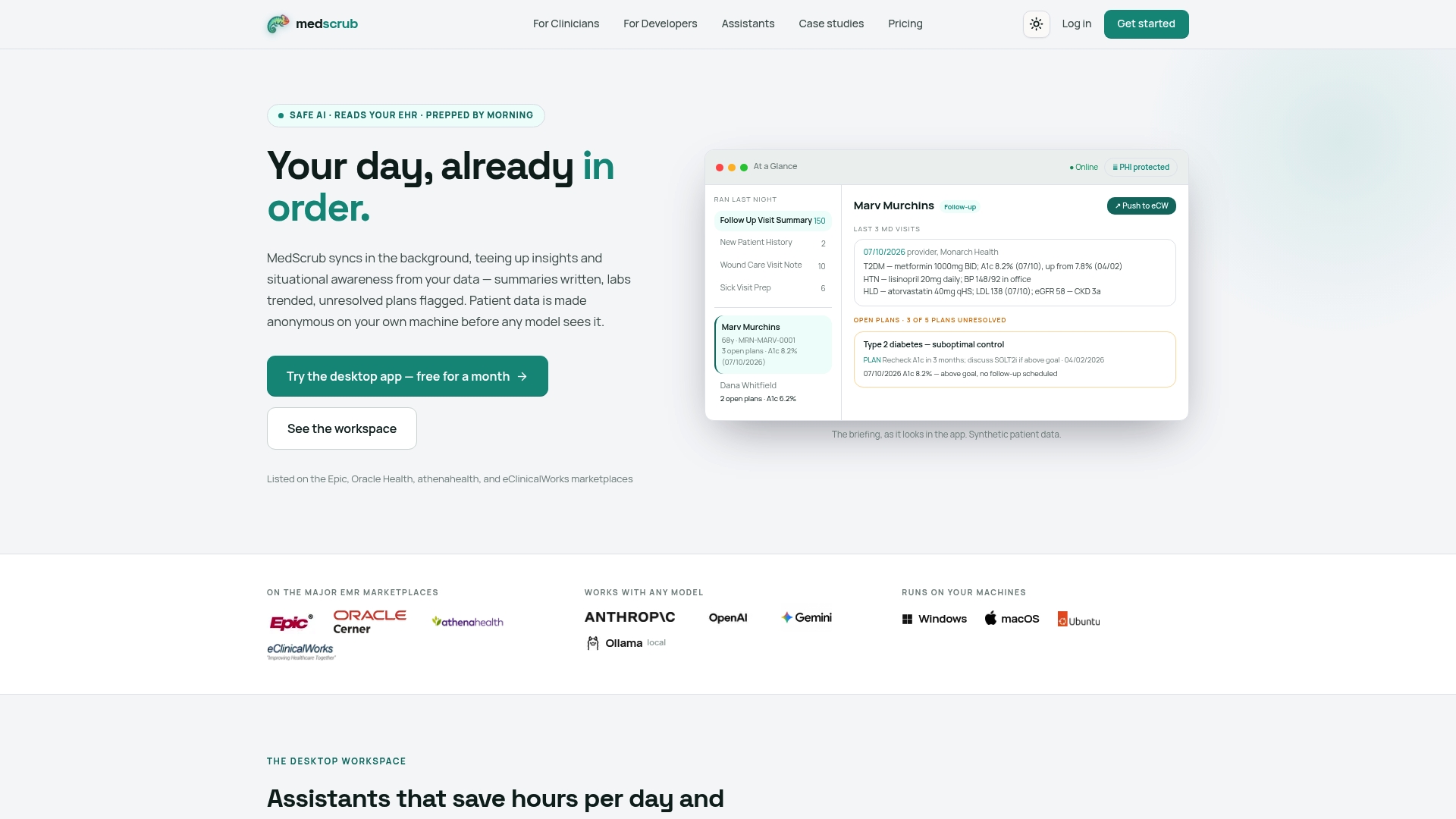
When you evaluate MedScrub or any competing tool, request five things upfront: proof of the EMR connector working with your specific system, a sample BAA, a plain description of the de-identification method, real pilot metrics from an existing deployment, and details on how the clinician signoff workflow gets built into daily use. Clinicians can see what a chart-aware assistant looks like day-to-day on the MedScrub physician page, and technical teams evaluating the PHI proxy and integration options should check the developer documentation. Book a demo focused on your specific EMR and specialty before committing to a full rollout.
Sources
- Evaluation of an ambient artificial intelligence documentation platform for clinicians
- Application of AI tools and clinical documentation burden: systematic review and meta-analysis
- Navigating AI compliance with HIPAA essentials
FAQ
What Is a Clinical AI Chatbot?
It’s a chart-aware assistant, integrated with an EMR, that drafts notes, summaries, and reminders for clinicians rather than talking directly to patients.
Is a BAA Always Required for a Medical AI Chatbot?
A BAA is required whenever a vendor hosts or processes protected health information, including audio, transcripts, or notes, according to HHS guidance.
How Much Time Can Ambient AI Documentation Actually Save?
A JAMA Network Open pilot found average time in notes dropped from 6.2 to 5.3 minutes per appointment, alongside reduced measures of clinician cognitive load.
Does MedScrub Keep PHI Off the Cloud?
MedScrub performs PHI de-identification on-device before data leaves clinician hardware, an approach documented in its eSpiral case study.
What Should a Pilot Track to Prove a Clinical AI Chatbot Works?
Track time in notes, the edit rate on AI-generated drafts, and downstream order-correction events, the same metrics a systematic review of documentation tools used to measure workload reduction.


