Only 17 of 157 Healthcare RAG Studies Tested Workflows for Clinicians
· 18 min read

Only 17 of 157 Healthcare RAG Studies Tested Workflows for Clinicians
RAG grounds large language model outputs in retrieved clinical text, cutting hallucination risk in ways closed-book generation cannot match. It is genuinely strong at EHR summarization, clinician question-answering, and evidence-grounded diagnostic support with the right caveats. It is not yet uniformly deployment-ready, though: most published evidence comes from offline testing, and the gap between benchmark performance and workflow safety is exactly where healthcare RAG projects stall.
TL;DR:
- Nearly 90% of healthcare RAG studies rely solely on offline testing, with limited prospective clinical validation or safety assessments.
- Hybrid retrieval methods combining dense and sparse strategies are most effective for clinical tasks, especially when accurate source attribution and exact-term matching are critical.
- Building and maintaining knowledge graphs, like MedRAG, enhance diagnostic specificity but require significant engineering investment and are less common in early deployments.
- Proper indexing, retrieval, and prompt structuring are crucial for deployment, with attention to PHI safety through on-device anonymization and strict access controls.
- Layer-specific evaluation, including retrieval recall, evidence provenance, and clinical safety tests, is essential for transitioning RAG systems from prototypes to real-world workflows.
Table of Contents
- What Is Healthcare RAG and How Does the Pipeline Work?
- Where Does RAG Actually Help Clinicians Today?
- Does the Research Actually Support Clinical Deployment?
- How Do You Build a Technically Sound Healthcare RAG Pipeline?
- How Should Teams Handle PHI in a Healthcare RAG System?
- What Should a Layered Evaluation Framework Look Like?
- What Are the Real Limitations Teams Need to Communicate?
- A Practical Roadmap for Your First Pilot
- Where MedScrub Fits Into a PHI-Safe RAG Deployment
- Sources
- FAQ
What Is Healthcare RAG and How Does the Pipeline Work?
Retrieval-augmented generation pairs a language model with a search step: instead of answering purely from what it learned during training, the model retrieves relevant documents at inference time and generates its response grounded in that retrieved evidence. In healthcare, this typically means pulling from clinical guidelines, EHR notes, lab records, or medical literature before the model drafts a summary, answer, or recommendation.
The pipeline has three moving parts, and each one is a place where quality can quietly degrade. First comes indexing: source documents get chunked, embedded, and stored so they can be searched quickly. Segmentation decisions matter enormously here. Split a discharge summary into chunks that are too small, and you lose the context connecting a medication to its indication. Split it too large, and irrelevant text dilutes the retrieval signal. Second is retrieval itself, where a query pulls the most relevant chunks. Third is generation, where the model synthesizes retrieved passages into a coherent, hopefully faithful answer.
Retrieval methods break into three broad categories, and the choice shapes everything downstream:
- Dense retrieval uses vector embeddings to capture semantic meaning, which helps when a clinician’s query uses different wording than the source document (asking about “heart failure” when the note says “cardiomyopathy”).
- Sparse retrieval relies on keyword and term-frequency matching (think BM25), which excels at exact-term precision, critical for drug names, dosages, or lab codes where a near-miss embedding match is worse than useless.
- Hybrid retrieval combines both, and it’s the approach the PLOS Digital Health systematic review associates with the strongest results in high-stakes clinical tasks, since it catches what either method alone would miss.
Architecturally, RAG systems in healthcare fall into three tiers of sophistication. Naive RAG does a single retrieve-then-generate pass, simple but brittle when the first retrieval misses the mark. Advanced RAG adds query rewriting, reranking, and iterative retrieval, trading latency for accuracy. Modular RAG breaks the pipeline into swappable components, letting teams route different query types to different retrieval strategies.
Graph-structured retrieval is where things get interesting for clinical use. GraphRAG organizes knowledge as entities and relationships rather than flat text chunks, which suits medicine’s inherently relational structure: a disease connects to symptoms, symptoms to differentials, differentials to treatments. MedRAG builds on this by integrating a hierarchical diagnostic knowledge graph with EHR retrieval, and it demonstrably improves diagnostic specificity for conditions with overlapping presentations, the exact scenario where naive retrieval tends to blur distinctions a specialist wouldn’t. MedGraphRAG takes this further with triple-graph construction and a technique called U-Retrieval, reporting state-of-the-art results across nine medical Q&A benchmarks by improving both accuracy and source attribution. The tradeoff is cost: building and maintaining a clinical knowledge graph takes real engineering investment that flat-index RAG doesn’t require.
Where Does RAG Actually Help Clinicians Today?
The strongest healthcare RAG applications cluster around three jobs, and each has a distinct risk profile worth understanding before you build.
- Diagnostic support. RAG systems retrieve relevant case literature, guidelines, and similar patient presentations to suggest evidence-grounded differentials, not a diagnosis handed down as fact, but a ranked set of possibilities with the supporting evidence attached. MedRAG’s knowledge-graph approach shows particular strength here, reducing misdiagnosis risk for diseases that present similarly by pulling in the specific distinguishing features a flat-text retriever might miss. The caveat matters: this works as a second opinion generator, not a diagnostic replacement, and it needs a clinician to weigh the retrieved evidence against the actual patient in front of them.
- EHR summarization. This is arguably the most mature use case in production today. A RAG system retrieves relevant notes, labs, and prior encounters, then generates a condensed problem-based summary, a chart-prep brief, or a lab-trend overview. The value proposition is time, not novel insight: turning twenty scattered notes into one coherent read before a visit.
- Medical question-answering. Clinicians use RAG-backed tools to get fast, cited answers to point-of-care questions, drug interaction checks, dosing thresholds, guideline lookups, without leaving their workflow to search a separate database. This is also the most heavily studied use case in the literature, partly because it’s the easiest to benchmark against existing medical QA datasets.
A useful way to picture this: a hospitalist opens a chart for a patient readmitted with shortness of breath. A RAG-backed summarization tool has already pulled the last three discharge summaries, flagged an unresolved medication reconciliation issue, and surfaced a lab trend showing gradually worsening renal function that nobody explicitly flagged. None of that required new medical reasoning. It required someone, or something, to actually read everything and connect it. That’s the gap RAG-based EHR summarization is built to close, and it’s the same gap MedScrub’s clinician-facing tools target with automated chart prep and care-gap tracking.
Real deployments tend to combine more than one of these applications. A diagnostic support tool is far more useful when it’s already working from a clean, RAG-generated summary of the patient’s history rather than raw, unsorted chart data. The applications aren’t separate products so much as layers in the same pipeline.
Does the Research Actually Support Clinical Deployment?
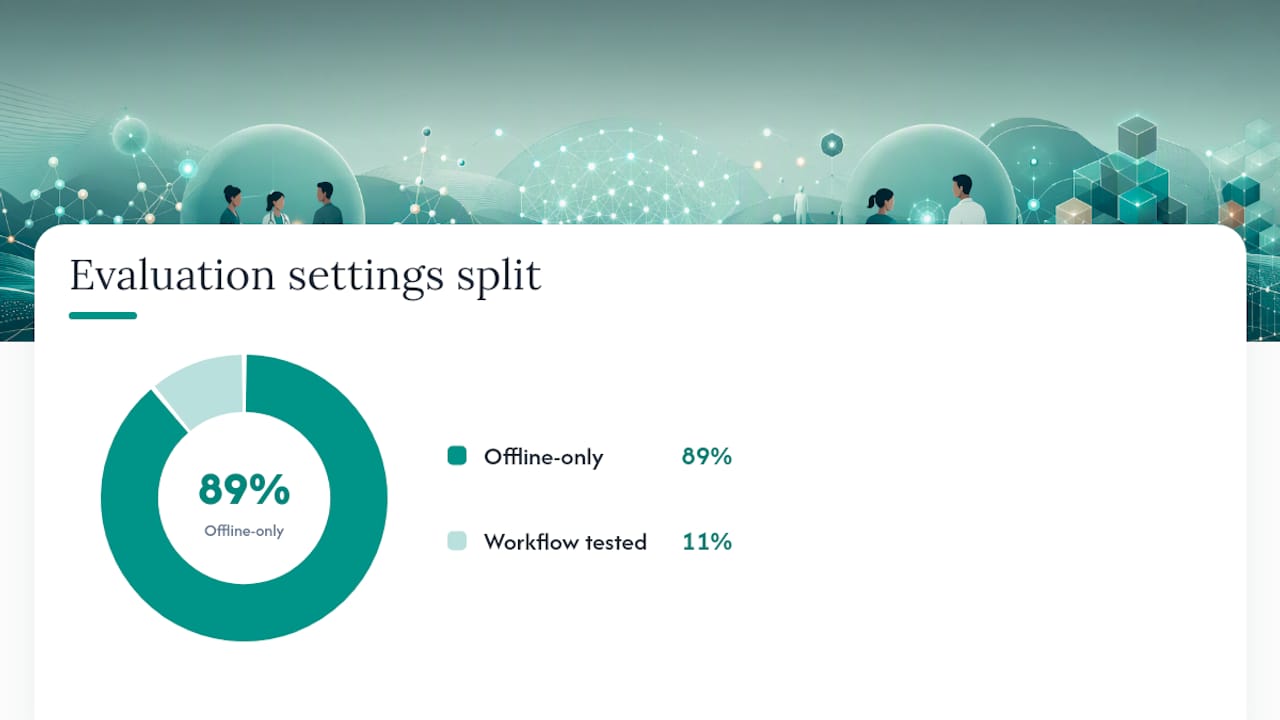
Here’s the uncomfortable finding underneath most of the enthusiasm: a scoping review mapping 157 studies of inference-time RAG and GraphRAG systems in healthcare found that 140 relied on offline-only evaluation, testing against static benchmark datasets rather than real clinical workflows. Only 17 included any workflow-facing or prospective component.
By the numbers: Of 157 healthcare RAG and GraphRAG studies reviewed, roughly 89% used offline-only evaluation. Fewer than 11% tested the system in an actual clinical workflow or prospective setting.
That imbalance shapes what we actually know. Offline evaluation answers “can this model retrieve the right passage and generate a plausible answer on a fixed test set?” It does not answer “does this system behave safely when a real clinician, under time pressure, trusts an output that turns out to be subtly wrong?” Those are different questions, and healthcare RAG research has overwhelmingly answered the first one.
The coverage gaps break down into a few specific blind spots:
- Retrieval-layer metrics are frequently skipped entirely; studies report final-answer accuracy without ever measuring whether the retrieved passages were actually relevant.
- Evidence linkage and provenance (did the generated claim actually trace back to the cited source, or did the model hallucinate a citation that sounds plausible) gets little formal testing.
- GraphRAG intermediate artifacts, the subgraphs and reasoning paths a graph-based system constructs before generating an answer, are almost never independently evaluated, even though errors introduced at that stage propagate directly into the final output.
- Formal safety testing, adversarial queries, edge cases, and failure-mode analysis, remains rare relative to the volume of accuracy-focused benchmarking.
The PLOS Digital Health systematic review adds a related concern: most implementations lean on proprietary models like GPT-3.5 and GPT-4, and the field still lacks a standardized evaluation framework that would let one study’s results be meaningfully compared to another’s. Every team is effectively grading its own homework with its own rubric.
None of this means the technology doesn’t work. It means the confidence interval around “how well does it work in practice” is wider than the benchmark tables suggest. Inference-time retrieval augmentation genuinely increases traceability compared to a closed-book model, but traceability isn’t the same thing as guaranteed evidence relevance or clinical safety, and treating benchmark accuracy as a stand-in for deployment readiness is the single most common overreach teams make when presenting RAG results to clinical stakeholders.
How Do You Build a Technically Sound Healthcare RAG Pipeline?
The engineering decisions that separate a demo from a deployable system mostly happen before generation ever occurs. Get indexing and retrieval right, and prompting problems shrink. Get them wrong, and no amount of prompt engineering fixes it.
Indexing. Segmentation strategy is the first fork in the road. Clinical notes benefit from semantic chunking that respects section boundaries (history of present illness, medications, assessment and plan) rather than fixed-token windows that might slice a sentence in half. Attach rich metadata to every chunk: source document type, encounter date, author role, and confidence tier if the source itself carries uncertainty. Version your embeddings. When you swap embedding models, and you will, old and new vectors are not comparable, so re-index rather than mixing generations silently.
Retrieval and reranking. A hybrid retrieval setup combining dense embeddings with sparse keyword matching catches more of what matters than either alone, particularly for exact-term needs like drug names and dosing units where a semantically “close” embedding match can be clinically wrong. Add a reranking stage after initial retrieval; a cheap first-pass retriever followed by a more expensive but accurate reranker on the top candidates tends to outperform either running alone. Layer in evidence-credibility filters that downweight or flag low-quality sources, an outdated guideline should not rank alongside a current one just because it’s semantically similar.
Prompting and attribution. Every generated clinical claim should carry a traceable link back to its source chunk. This isn’t just good practice, it’s the difference between a system a clinician can verify in ten seconds and one they have to take on faith. Structure prompts so the model is instructed to decline or hedge when retrieved evidence is thin or contradictory, rather than smoothing over the gap with confident-sounding prose. This single instruction pattern does more to reduce hallucination risk than most downstream filtering.
- Segment by clinical section, not fixed token count.
- Tag every chunk with source type, date, and author role.
- Run hybrid dense-plus-sparse retrieval before generation.
- Rerank top candidates with a dedicated scoring model.
- Require every generated claim to cite its source chunk.
- Instruct the model to hedge explicitly on thin evidence.
Runtime monitoring. Retrieval quality tends to drift as your document corpus grows and clinical language evolves. Track retrieval telemetry continuously: what fraction of queries return zero high-confidence matches, how often reranking meaningfully reorders the initial list, and how retrieval precision trends over time. Feed clinician corrections and flags directly back into evaluation data rather than treating them as support tickets to close and forget.
Latency and scaling. Clinical workflows have real time budgets. A chart-prep summary generated overnight can tolerate a few seconds of retrieval latency per document. A point-of-care QA tool a clinician is using mid-visit cannot; anything past one or two seconds breaks the interaction. Cache embeddings for frequently accessed reference material (standard guidelines, formulary data) since those change far less often than patient-specific data, and reserve your latency budget for the parts of the pipeline that actually need freshness.
Pro Tip: Build your retrieval evaluation set before you build your generation prompts. If you can’t yet measure whether retrieval is pulling the right evidence, you have no way to tell whether a bad final answer is a retrieval failure or a generation failure, and you’ll waste weeks tuning the wrong layer.
How Should Teams Handle PHI in a Healthcare RAG System?
Every stage of a RAG pipeline is a potential PHI exposure point, not just the obvious one. The index itself can leak patient identifiers if embeddings are built from raw notes. Retrieval logs, kept for debugging, can accumulate a shadow copy of sensitive queries and returned passages. Even a model’s generated output can inadvertently restate identifying details pulled from a retrieved chunk.
Three architectural patterns address this, with real tradeoffs between them:
- On-device anonymization strips or tokenizes identifiers before data ever leaves the clinician’s machine, meaning PHI never transits to a cloud index at all.
- Reversible de-identification replaces identifiers with tokens that can be mapped back only within the local environment, preserving clinical utility (a de-identified chart still needs to make sense as one patient’s continuous story) while keeping the exposed data anonymous everywhere else.
- On-premises or self-hosted indices keep the entire retrieval corpus inside institutional infrastructure rather than a third-party cloud, paired with strict role-based access control limiting who can query which patient’s data.
Governance has to sit on top of whichever architecture you choose. That means regular audits of what’s actually indexed, minimal retention windows for logs and cached queries, and clear consent handling for any data used to fine-tune or evaluate the system. The AHRQ safety risk assessment framework offers a useful structural model here, borrowed from facility safety design but applicable to prioritizing which data-handling risks need mitigation first.
A RAG pipeline can hit strong benchmark accuracy and still fail an institutional privacy review if it was never designed to keep patient identifiers out of the retrieval index in the first place. Architecture decisions made in the first week of a project determine whether the compliance conversation in month six is easy or painful.
One version of this pattern in production uses on-device anonymization paired with direct EMR syncing, so chart data can be processed for summarization and reminders without PHI leaving the clinician’s machine. The eSpiral case study documents this specific architecture in a live clinical deployment, and the broader case study collection covers additional workflow-facing examples worth reviewing if you’re evaluating architectural options.
What Should a Layered Evaluation Framework Look Like?
Offline accuracy on a single benchmark tells you almost nothing about whether a system is safe to put in front of a clinician. A defensible evaluation plan tests each layer of the pipeline separately, then validates the whole thing in progressively more realistic settings.
- Retrieval-layer metrics. Measure recall (did the relevant document get retrieved at all) and precision (how much of what got retrieved was actually relevant) independently of generation quality. A system can generate a fluent, well-structured answer built entirely on the wrong retrieved evidence, and pure output-accuracy scoring will miss that failure completely.
- Evidence-linkage evaluation. Check that every claim in the generated output traces correctly back to its cited source. This is provenance correctness, not just “did it cite something,” but “does the citation actually support the specific claim attached to it.”
- Generator faithfulness. Apply faithfulness scoring approaches (FactScore-style methods that check each generated statement against retrieved evidence) to catch cases where the model adds detail the retrieved passages never supported.
- Safety metrics. Test adversarial and edge-case queries deliberately, ambiguous symptoms, contradictory guidelines, rare conditions, rather than only benchmark-typical cases the system was likely to handle well anyway.
For human evaluation, rater selection matters more than most teams assume. Clinical raters with domain expertise catch errors that generic annotators miss entirely, particularly subtle ones around clinical plausibility. Interrater reliability should be measured and reported, not assumed; two clinicians disagreeing on whether an output is “faithful” is itself useful data about how ambiguous the task is.
Deployment validation should move through stages rather than jumping straight to full rollout: shadow mode first, where the system runs alongside existing workflow without its output being acted on, followed by a small clinician-in-the-loop pilot with explicit feedback capture, then staged rollout with runtime monitoring active from day one. This staged approach directly answers the gap the scoping review identified: the scarcity of workflow-facing prospective evaluation is precisely what shadow-mode and pilot testing are designed to fill.
What Are the Real Limitations Teams Need to Communicate?
Domain shift is a persistent problem: a RAG system tuned on general medical literature can underperform on a specific institution’s patient population, documentation style, or specialty focus, and most published benchmarks don’t capture that variance. Dataset coverage skews toward well-studied conditions and common QA formats, leaving rarer presentations and less-documented specialties thinner on evaluated performance.
The field’s lack of standardized evaluation makes cross-study comparison unreliable; a “90% accuracy” claim from one team’s benchmark may not mean the same thing as another’s. Regulatory pathways add another layer of uncertainty, particularly around how FDA oversight applies to AI tools that inform rather than directly make clinical decisions, and organizational adoption barriers (clinician trust, workflow disruption, liability concerns) often outweigh the technical hurdles.
Research priorities worth tracking:
- Formal evaluation methods for GraphRAG’s intermediate artifacts (subgraphs, reasoning paths), not just final answers.
- Fine-grained, claim-level verification methods rather than whole-response scoring.
- Continuous evaluation pipelines that catch drift after deployment, not just at launch.
- Domain-specific knowledge graphs and GraphRAG methods, which show real promise for narrowing domain-shift gaps when properly constructed and evaluated.
A Practical Roadmap for Your First Pilot
If you’re planning a first healthcare RAG deployment, sequence matters more than sophistication. Start with curated, well-segmented indexing before touching architecture, a modest index built carefully outperforms a sprawling one built carelessly. Build retrieval-layer tests before generation tests; you cannot debug what you cannot measure separately. Wire in a clinician feedback loop from day one of the pilot, not after go-live, since early corrections are cheaper to act on than a pattern discovered six months in.
The field would benefit enormously from more teams publishing layer-specific results rather than a single blended accuracy number. A retrieval precision score and a faithfulness score, reported separately, tell a far more honest story than one aggregate metric that hides which layer actually needs work.
— Clint
Where MedScrub Fits Into a PHI-Safe RAG Deployment
Medscrub is the practical option for teams that need chart-aware RAG capability without building a PHI-handling architecture from scratch. On-device anonymization strips identifiers before any data leaves the clinician’s machine, addressing the index-leakage and retrieval-exposure risks covered above at the architecture level rather than through policy alone.
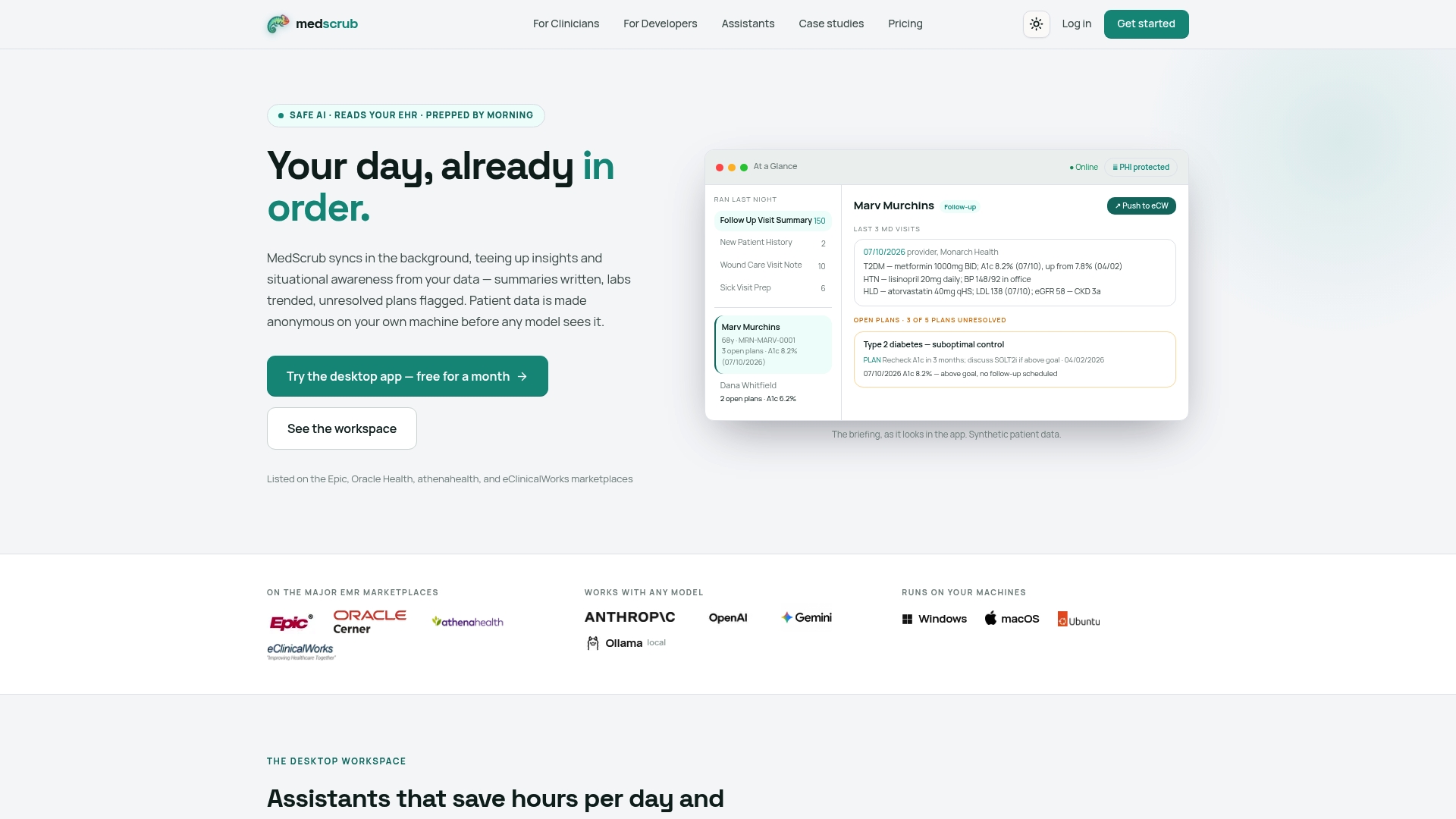
Connectors can sync with major EMR systems, and automated chart prep, problem-based summaries, and care-gap tracking support EHR summarization use cases. For engineering teams evaluating integration paths, the developer API and PHI proxy support on-premises and native desktop deployment with reversibly de-identified FHIR access, letting you build against real patient data without the exposure risk. Clinicians can start a trial to see the chart-prep and summarization workflow directly against their own EMR, or review the Monarch Health deployment for a concrete example of nightly chart prep running in production.
This article is general information, not a substitute for advice from a qualified doctor. Consult a qualified healthcare professional about your own circumstances before acting on anything here.
Sources
- Evaluation Methods for Inference-Time Retrieval-Augmented and Graph Retrieval-Augmented Large Language Models in Health Care: Scoping Review
- Retrieval-Augmented Generation (RAG) in Healthcare: A Comprehensive Review
- Retrieval-Augmented Generation (RAG) approaches in healthcare: systematic review (PLOS Digital Health)
- MedRAG: Enhancing Retrieval-augmented Generation with Knowledge Graph-Elicited Reasoning for Healthcare Copilot
FAQ
What Is the Difference Between RAG and GraphRAG in Healthcare?
Standard RAG retrieves flat text chunks based on similarity search, while GraphRAG organizes clinical knowledge as connected entities and relationships, which better captures how diseases, symptoms, and treatments relate to each other.
Is Healthcare RAG Ready for Direct Clinical Decision-Making?
Not for autonomous decisions. The evidence base is strong for EHR summarization and evidence-grounded QA, but most studies rely on offline evaluation rather than prospective clinical validation, so RAG currently works best as a clinician-supervised support tool.
How Does MedRAG Improve Diagnostic Accuracy?
MedRAG combines a hierarchical diagnostic knowledge graph with EHR retrieval, which improves specificity for diseases with overlapping presentations compared to flat-text RAG baselines.
What Retrieval Method Works Best for Clinical Text?
Hybrid retrieval, combining dense semantic embeddings with sparse keyword matching, generally outperforms either method alone, especially for exact-term needs like drug names and dosages.
How Can Healthcare Organizations Keep PHI Safe in RAG Systems?
On-device anonymization, reversible de-identification, and on-premises indices with strict role-based access control are the three main architectural patterns; Medscrub applies on-device anonymization paired with direct EMR syncing as one implementation of this approach.


