Cut AI Hallucinations 70–80% for Healthcare Developers with RAG
· 19 min read

Cut AI Hallucinations 70–80% for Healthcare Developers with RAG
To reduce AI hallucinations in production, combine grounding through retrieval-augmented generation with an enforced citation contract, layered oversight modeled on HALO, inference-time detectors or self-correction, and consensus selection through Minimum Bayes Risk. Every layer needs a calibrated abstention path and a trace log, because in regulated domains an ungrounded answer is worse than no answer. Start with retrieval and prompt controls, add detectors once you have baseline metrics, then check the deployment checklist below before shipping, leveraging insights from AI-powered dental practice management to simplify clinical workflows.
TL;DR:
- Retrieval-augmented generation combined with citation enforcement, layered oversight, and inference-time detectors significantly reduces hallucinations in high-stakes AI applications.
- Tuning retrieval index quality, embedding models, and chunking strategies is critical to ensure precise and up-to-date factual grounding, especially in clinical domains.
- Using low-temperature prompts, multiple candidate generation, and structured output schemas further lowers hallucination rates and increases response reliability.
- Implementing HALO-style layered oversight, including traceability, calibrated abstention, and continuous audits, enforces factual correctness throughout the AI pipeline.
- Detectors focused on numeric checks, citation verification, and in-loop self-correction are most effective for targeted error types, while ensemble selection handles stochastic errors in critical claims.
Table of Contents
- What Techniques Actually Reduce AI Hallucinations?
- How Do You Ground Outputs With Retrieval-Augmented Generation?
- Which Prompt and Decoding Settings Lower Hallucination Rates?
- What Is HALO-Style Layered Oversight and How Do You Build It?
- Do Inference-Time Detectors Catch Hallucinations Before They Ship?
- Can Ensemble Selection (HUMBR) Reduce Stochastic Hallucinations?
- How Do You Measure and Test for AI Hallucinations?
- What Should a Production Hallucination-Mitigation Checklist Include?
- How Does MedScrub’s Architecture Map to Hallucination Mitigation?
- A Starter Architecture Worth Actually Testing
- Reduce Fabrication Risk With PHI-Safe, Chart-Aware AI
- Sources
What Techniques Actually Reduce AI Hallucinations?
Not every fix belongs in every system. Some techniques cost you an afternoon of engineering; others cost you a new inference pipeline. Here’s the priority order that tends to work, roughly from cheapest to most involved:
- Retrieval-augmented generation (RAG): grounds outputs in retrieved documents instead of relying on parametric memory. This is almost always step one, because it attacks the most common cause of fabrication: the model answering from a hazy internal prior instead of an actual source.
- Citation contract: a structural rule requiring every factual claim to point to a specific retrieved passage, with a defined fallback (“I don’t know”) when no passage supports the claim.
- Prompt and decoding controls: lower temperature, structured output schemas, and explicit permission to abstain. Cheap to implement, meaningful in effect.
- Token-level detectors: lightweight, often regex-based or numeric checks that catch a narrow but high-value class of errors, like invented statistics or wrong dates.
- HALO-style layered oversight: a system architecture that treats hallucination as an enforceable property rather than a model quirk, chaining grounding, verification, and abstention into one pipeline.
- Once-More style self-correction: continuous, in-loop verification using perplexity signals and a verifier model, useful for reasoning-heavy tasks where errors compound across steps.
- HUMBR-style ensemble/MBR selection: generate multiple candidates and pick the one closest to consensus, or abstain if consensus is weak.
For most workloads, RAG plus a citation contract plus decoding controls covers 70 to 80 percent of the practical gain, based on how these methods are typically layered in production. High-stakes domains, healthcare chart summarization among them, need the full stack: layered oversight, detectors, and ensemble selection, because a 2025 clinical evaluation on cancer-information chatbots found that RAG alone reduced hallucinations without eliminating them. Ensembles and full neural detectors add the most latency and the most engineering overhead, so reserve them for the claims that actually carry clinical or financial risk, not every token the model produces.
How Do You Ground Outputs With Retrieval-Augmented Generation?
RAG works by intercepting a query before generation, retrieving relevant passages from a curated index, and forcing the model to answer from that context instead of its training weights. OpenAI’s developer guidance on optimizing accuracy treats retrieval as the primary lever for factual grounding, ahead of fine-tuning, and that ordering matters: fine-tuning shapes tone and behavior, but it rarely fixes a model’s tendency to invent facts the way a well-tuned retriever does.
Building the pipeline means making four decisions correctly:
- Index creation: decide what belongs in the corpus. A narrow, curated index of verified clinical guidelines beats a broad scrape of every PDF you can find, because retrieval quality caps generation quality.
- Embeddings: choose an embedding model matched to your domain vocabulary. General-purpose embeddings often misrank dense technical text, especially medical abbreviations and drug names.
- Chunking strategy: split documents so each chunk contains a complete, self-contained fact. Splitting mid-sentence or mid-table is a leading cause of retrieval returning a technically relevant but semantically broken passage.
- Retriever tuning: test retrieval precision independently of generation. If your retriever returns the wrong passage, no amount of prompt engineering downstream will fix the answer.
Quote-first patterns push this further: instead of asking the model to summarize a topic, ask it to extract the exact sentence that answers the question, then build the response around that quote. This flips the failure mode from “invent an answer” to “fail to find a quote,” which is a far safer failure.
That’s where the citation contract comes in. Every factual claim in the output must carry a pointer to a specific retrieved passage. If no passage supports a claim, the model must say so rather than filling the gap with a plausible-sounding guess. This single rule, enforced at the prompt and output-validation level, does more to kill fabricated citations than any amount of generic instruction to “be accurate.”
Pro Tip: Test your citation contract by feeding it a question you know has no answer in your corpus. If the model produces a confident answer anyway, your contract isn’t enforced, it’s just requested.
Three pitfalls show up constantly in production RAG systems. Stale indexes return outdated guidance that was correct last year but wrong today, particularly dangerous in clinical settings where treatment protocols change. Overly broad corpora dilute retrieval precision, since a bigger index isn’t a better index if it buries the right passage under a thousand tangential ones. And partial-match citations, where the model cites a real document that doesn’t actually support the specific claim it’s attached to, are the most insidious failure because they look verified on inspection. The remedy for all three is the same discipline: audit your index quarterly, keep corpora scoped tightly to the task, and spot-check citations against their claimed passages, not just their existence.
Which Prompt and Decoding Settings Lower Hallucination Rates?
Temperature is the first knob worth touching. For factual, extraction-heavy tasks, keep temperature between 0 and 0.3. Practitioner guidance from MIT Sloan backs this range for narrow factual work, reserving higher temperatures for genuinely creative tasks where variation is the point, not the risk.
When a single low-temperature pass isn’t reliable enough, best-of-N sampling or majority voting across multiple generations catches errors that slip through individually. Generate three to five candidates, compare them, and either pick the consensus answer or flag disagreement for human review. This is a cheaper cousin of full ensemble selection and works well as an intermediate step before committing to a heavier architecture.
Prompt templates matter more than most teams assume. A few patterns consistently help:
- Explicitly request “quote the exact source sentence” rather than “summarize the source.”
- Require structured output (JSON with a citation field, for instance) so missing citations are a schema violation, not a stylistic gap.
- State plainly that “I don’t know” or “not found in the provided documents” is an acceptable, expected answer, not a failure. Anthropic’s own guidance on reducing hallucinations makes this same point: giving the model explicit permission to abstain reduces confident fabrication more than any amount of stern instruction to “only say true things.”
Chain-of-thought prompting is a genuine trade-off, not a free win. Asking a model to reason step by step sometimes surfaces the exact point where it goes wrong, which is useful for debugging. But it can also do the opposite: manufacture a confident, plausible-sounding chain of reasoning that arrives at a wrong answer with more apparent authority than a direct answer would have had. Use chain-of-thought when you plan to inspect the reasoning trace, not just the final answer.
Set up prompt experimentation like any other engineering change: hold a fixed test set of factual queries with known answers, vary one setting at a time (temperature, then template, then sampling strategy), and track hallucination rate against latency. Skipping this step and shipping “a prompt that felt better” is how teams end up debugging regressions blind six months later.
What Is HALO-Style Layered Oversight and How Do You Build It?
Zero hallucination isn’t a property you get from a better model. It’s a property you engineer into the system, and that’s the core argument behind HALO, a six-layer oversight architecture for enterprise AI. Instead of hoping a model behaves, HALO treats faithfulness as something enforced at each stage of the pipeline, so a failure at one layer gets caught by the next.
The six layers, and how to build each one, look like this:
- Grounded generation: every response must originate from retrieved, verifiable context. This is your RAG layer, discussed above, functioning as the foundation everything else sits on.
- Constrained execution: limit what the model can actually do. Tool interfaces with fixed schemas, deterministic extractors for dates and numbers, and restricted output formats all shrink the space in which the model can improvise.
- Multi-signal verification: don’t trust one check. Combine citation presence, numeric-format validation, and semantic similarity between claim and source into a single verification score.
- Calibrated abstention: define a confidence or evidence threshold below which the system says “I don’t know” instead of guessing. This threshold needs actual tuning against a labeled test set, not a guess.
- Traceability: log which retrieved passage, which prompt version, and which model generated every claim. Without this, debugging a hallucination six weeks after it shipped is close to impossible.
- Continuous oversight: schedule recurring audits of live outputs against ground truth, because a system that passed evaluation in January can drift by June as your data or user queries shift.
The practical engineering pattern that ties these together is straightforward: use deterministic extractors wherever a value has an exact, checkable form (a lab result, a dosage, a date), reserve constrained tool interfaces for anything the model would otherwise have to improvise, and score every claim against its source passage before it reaches the user.
Pro Tip: Set your abstention threshold using a held-out set of claims you already know are true or false, not intuition. A threshold tuned on ten example prompts will misbehave the moment real traffic hits it.
Choosing where to set that threshold is a latency-for-assurance trade. A tighter threshold catches more risky claims but pushes more queries into abstention or human review, which slows the pipeline and frustrates users expecting an answer. A looser threshold moves faster but lets more unsupported claims through. In healthcare-adjacent deployments, the HALO paper’s own framing argues for erring toward abstention, since an unresolved query is recoverable and a fabricated clinical claim is not.
Do Inference-Time Detectors Catch Hallucinations Before They Ship?
Detectors that run inside the generation loop catch a narrower class of errors than RAG or oversight architectures, but they catch them with precision. A deterministic numeric detector, for instance, is a regex or rules-based check that flags a generated number not present in the retrieved context, and it can be wired in as a LogitsProcessor that suppresses or penalizes tokens before they’re sampled.
LettucePrevent’s findings put a real number on this approach: deterministic number detectors achieved a relative reduction of more than 60 percent in numeric hallucinations, one of the more concrete effect sizes in this space. That’s a meaningful gain for a narrow but high-consequence category of error, since a fabricated dosage or lab value is exactly the kind of mistake a clinician can’t catch by reading tone.
Neural in-loop detectors, which try to catch a broader range of factual errors than a numeric regex can, come with a real constraint: they need tokenizer alignment between the detector and the generating model. A detector trained against one tokenizer’s segmentation often fails silently when deployed against a model using a different one, which is a subtle enough failure mode that teams sometimes ship it without noticing.
Once-More takes a different approach: instead of a single detector checking output after the fact, it runs continuous, unit-level self-correction during generation, using token-level perplexity spikes as a trigger and a separate verifier model to check and revise flagged spans. The Once-More framework reports strong results on reasoning-heavy benchmarks while staying more token-efficient than older iterative correction methods that regenerate whole responses. The catch is that its production viability depends heavily on verifier quality: a weak verifier or a badly tuned perplexity threshold can trigger unnecessary regeneration loops that burn tokens without fixing anything.
The practical split is this: reach for lightweight deterministic detectors, numeric checks, date validators, citation-presence checks, when the error class is narrow and well defined. Reach for a full neural in-loop verifier like Once-More when the task is reasoning-heavy and errors compound across steps, and you have the budget to tune and monitor a verifier model. Most teams get more value per engineering hour from the deterministic layer first.

Can Ensemble Selection (HUMBR) Reduce Stochastic Hallucinations?
Some hallucinations aren’t caused by bad grounding at all. They’re caused by sampling variance: the same prompt run five times produces five subtly different answers, and one of them happens to be wrong. Consensus-based selection targets exactly this failure mode.
HUMBR frames the problem as Minimum Bayes Risk selection: generate a diverse set of candidate outputs, score each candidate against every other using a hybrid utility function that blends semantic similarity and lexical overlap, and pick the candidate closest to the group’s centroid. If no candidate scores above a threshold τ, the system abstains rather than guessing.
Configuring this in practice means tuning a few parameters together, not independently:
- Ensemble size: five to ten candidates is a common working range, balancing diversity against inference cost, since generating more candidates directly multiplies your compute bill.
- Temperature spread: vary temperature slightly across candidates (say, 0.2 to 0.7) so the ensemble captures genuine variance rather than five near-identical outputs.
- Embedding model for similarity scoring: the model used to compute semantic closeness between candidates needs to match your domain, the same lesson that applies to retrieval embeddings.
HUMBR’s reported results show reduced contradiction rates and better recall on structured outputs compared with single-model baselines, and the method carries a theoretical guarantee under the assumption that hallucinations are sparse relative to correct outputs. The abstention threshold τ is the real lever here: set it conservatively and you’ll abstain more often but trust every answer that gets through; set it loosely and you’ll answer more queries at the cost of letting more disagreement slip past unflagged.
Ensembles cost more at inference time than any single-pass method on this list, so they’re best reserved for claims where a wrong answer is expensive: a diagnosis summary, a financial figure, a legal conclusion, not a casual conversational reply.
How Do You Measure and Test for AI Hallucinations?
You can’t manage what you don’t measure, and hallucination rate isn’t one number, it’s several. Track these in parallel:
- Factuality rate: the percentage of factual claims in a sample of outputs that are verifiably correct against ground truth.
- Hallucinated-citation rate: the percentage of citations that don’t actually support the claim they’re attached to, a distinct and often underreported failure mode from missing citations.
- Contradiction rate: how often the same query, run repeatedly, produces mutually inconsistent answers.
- Numeric hallucination count: instances of invented or altered numbers, trackable with a deterministic detector as described earlier.
- Abstention rate: how often the system correctly (or incorrectly) declines to answer, since a healthy system abstains on genuinely unsupported queries and answers everything else.
Test design needs three layers of coverage: a control set of straightforward factual queries with known answers, an adversarial set designed to bait the model into overconfident guesses (ambiguous questions, questions about topics absent from your corpus), and domain-specific benchmarks that reflect your actual production traffic rather than generic public benchmarks.
| Test layer | Purpose | Example approach |
|---|---|---|
| Control set | Baseline factuality on known answers | Fixed set of queries with verified ground truth |
| Adversarial set | Exposes confident guessing | Questions with no supporting passage in the corpus |
| Domain benchmark | Reflects real production risk | Sampled live queries, human-reviewed |
| Numeric audit | Catches invented figures | Deterministic detector run on all outputs |
Automate what you can. Deterministic detectors run cheaply on every single output and catch numeric drift continuously, not just at scheduled review time. Layer in scheduled audits, weekly or monthly depending on traffic volume, where a human reviewer samples a fixed percentage of outputs and scores them against the metrics above. Set alert triggers so a sudden jump in contradiction rate or a drop in abstention rate flags an on-call engineer rather than surfacing three weeks later in a support ticket.
When you do find a hallucination in review, capture the full context: the prompt, the retrieved passages, the model version, and the exact output. That trace is what turns a one-off bug report into a pattern you can actually fix, and it’s the same traceability discipline HALO builds into its architecture from the start.
What Should a Production Hallucination-Mitigation Checklist Include?
Before anything ships, confirm you have the minimum viable stack in place, not the full architecture, but the floor below which you shouldn’t deploy:
- Curated retrieval index scoped tightly to your domain, refreshed on a defined cadence.
- Citation contract enforcement, checked at the output-validation layer, not just requested in the prompt.
- Low-temperature policy (0 to 0.3) for any factual or extraction task.
- A verifier, deterministic at minimum, neural if your risk tolerance and budget support it.
- An abstention path that’s actually wired into the user-facing response, not a theoretical fallback nobody tested.
- Trace logs capturing prompt, retrieved context, model version, and output for every generation.
Once the floor is in place, set your service-level objectives deliberately. Decide your latency budget before you add a verifier or ensemble step, because each one adds real time and it’s easier to size that trade-off up front than to discover it in a postmortem. Tune your abstention threshold against a labeled test set, and decide in advance what abstention rate is acceptable for your use case. A clinical documentation assistant that abstains on 15 percent of queries might be exactly right; a customer support bot with the same rate probably isn’t.
Build the operational runbook alongside the technical stack. Define exactly when a flagged output escalates to a human reviewer, what triggers a retraining or reindexing cycle, and how often your dataset curation process runs to catch stale or low-quality sources before they degrade retrieval quality.
Pro Tip: Write your escalation runbook before your first production incident, not during it. Teams that improvise an escalation path under pressure almost always under-scope what counts as “needs human review.”
If you’re operating in healthcare, one more line item is non-negotiable: PHI-safe retrieval. Any indexed clinical data needs de-identification before it enters a retrieval corpus that might be logged, cached, or sent to an external API, and on-device de-identification is the more defensible pattern when PHI compliance is a hard requirement rather than a nice-to-have.
How Does MedScrub’s Architecture Map to Hallucination Mitigation?
The patterns above aren’t abstract when you’re handling patient charts. MedScrub’s on-device PHI anonymization is a direct implementation of the PHI-safe retrieval principle: de-identification happens locally before any data enters a retrieval pipeline or model call, which keeps the grounding layer usable without exposing protected health information.
The chart-aware assistant design maps to traceability and evidence-based extraction. Summaries, lab trends, and problem-based notes are generated against a specific patient’s chart data, which is the same quote-first, citation-anchored pattern described in the RAG section: the system pulls from a defined source rather than a generic prior, and that source is traceable back to the originating chart entry.
MedScrub’s case study with eSpiral illustrates the practical outcome of this design: AI functionality embedded directly in the chart workflow, with PHI never leaving the clinician’s machine. That’s the architectural choice that keeps a grounded, traceable assistant compliant without pushing patient data through an external retrieval index. Clinicians and technical evaluators interested in deployment specifics can review the full case study library for additional detail on how these patterns hold up across different practice settings.
A Starter Architecture Worth Actually Testing
If you’re building this from scratch, sequence your experiments instead of deploying everything at once. Start with RAG plus a citation contract, measure your baseline factuality and hallucinated-citation rate, then layer in low-temperature prompting and measure again. Add a numeric detector next, since it’s cheap and the effect size is real. Ensemble selection comes last, reserved for the highest-stakes claims your system produces, because it’s the most expensive layer for the smallest marginal audience.

Expect trade-offs at every step. Latency grows with each layer you add, coverage drops as your abstention threshold tightens, and manual review never fully disappears, particularly for claims where a wrong answer carries clinical or legal weight. That’s not a flaw in the architecture; it’s the honest cost of building a system that admits uncertainty instead of hiding it.
Instrument everything before you scale scope. A team that ships detectors and ensembles across their entire product surface without first validating gains on a narrow slice usually ends up debugging blind. Expand coverage only after your metrics prove the layer you just added is actually earning its latency cost.
— Clint
Reduce Fabrication Risk With PHI-Safe, Chart-Aware AI
If you’re building or deploying clinical AI, the grounding and traceability patterns covered above reflect best practices including on-device PHI anonymization before any data touches a model, so chart-aware summaries, lab trends, and SOAP note drafts stay grounded in a specific patient record instead of a generic language prior.
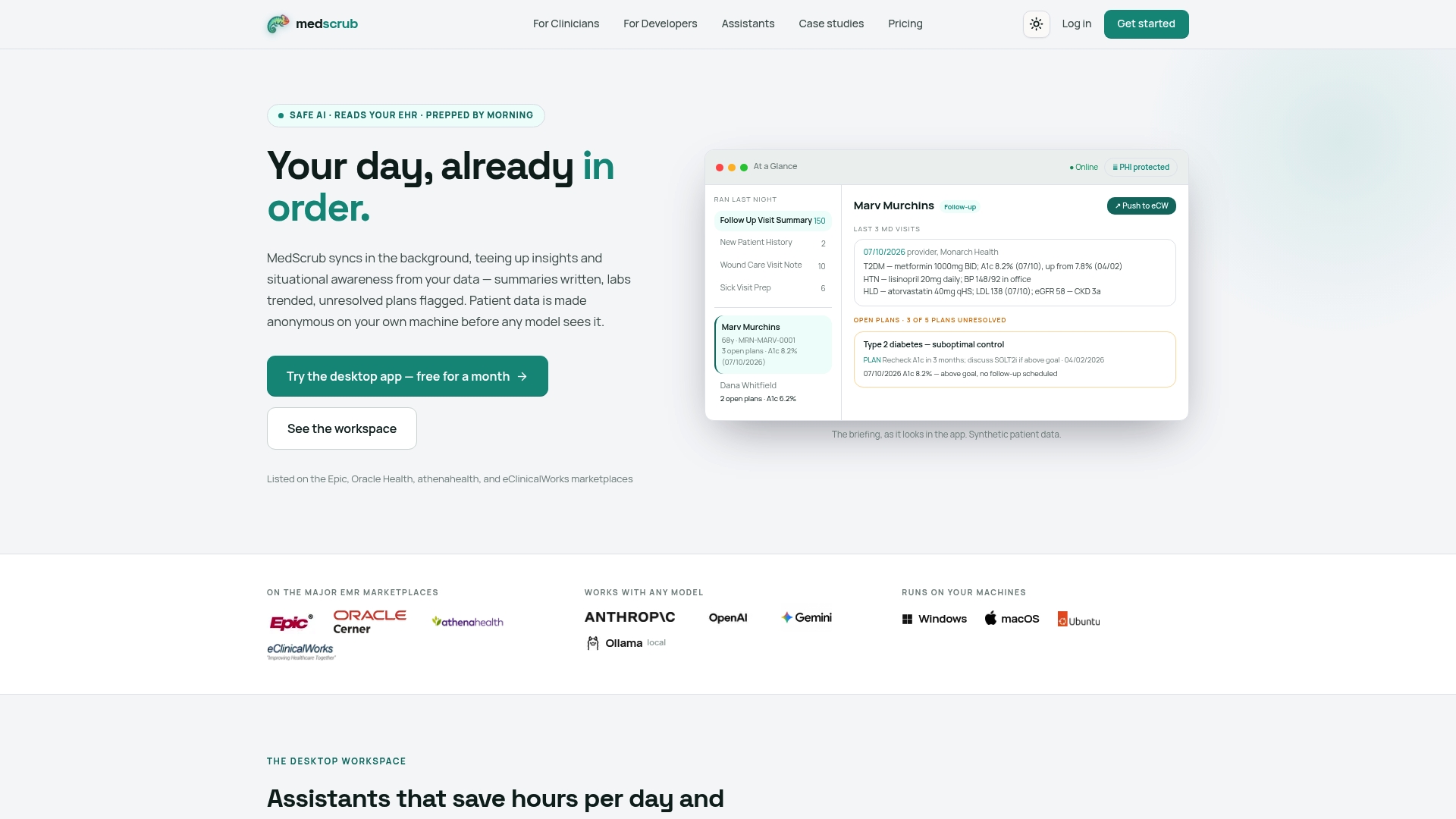
For clinicians evaluating a privacy-first assistant for daily documentation and follow-up tracking, the clinician-facing product page walks through the workflow features built for exactly this use case. Developers building custom integrations can review the developer API and PHI proxy documentation to see how reversible de-identification and FHIR access support grounded, traceable retrieval without exposing protected health information. Start with a trial on either page to see how the chart-aware model handles your own documentation load before committing to a full rollout.
Sources
- LettucePrevent - Real-Time Prevention of Factual Hallucinations in RAG (Hugging Face blog)
- Reducing Hallucinations and Trade-Offs in Responses in Generative AI Chatbots for Cancer Information: Development and Evaluation Study (PMC)


